
Electroplating Filtration System Selection Guide
Get Product Catalog & Support
Fill out the form to get full specs and case studies.
Choose an electroplating filtration system by matching bath chemistry, circulation flow and filter media. Calculate the required flow from the working bath volume and the process turnover rate, then check whether the proposed pump and filter can maintain that flow as the media loads.
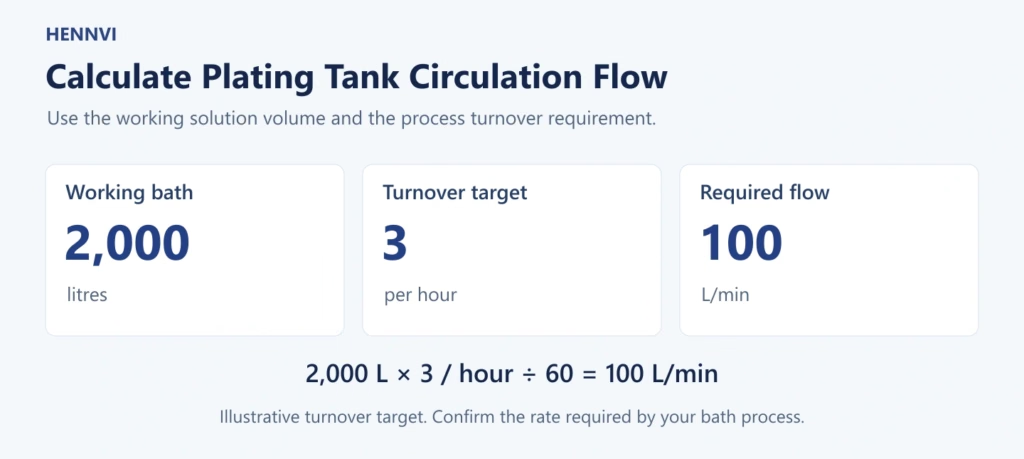
For example, a 2,000 L bath at three turnovers per hour requires 100 L/min through the installed filtration loop. HENNVI HSL catalogue capacities help shortlist a unit. The final selection also needs the pump curve, selected media, piping losses and operating temperature.
Table of Contents
Toggle1. Define the Bath and Filtration Requirement
Provide the bath composition, concentration, working volume and normal and maximum temperatures. Describe the contamination you need to control and the filtration requirements established by your bath chemistry supplier.
For continuous particle removal, specify the required retention and the expected solids load. Where the chemistry supplier calls for treatment of dissolved organic impurities, confirm the carbon treatment method, schedule and additive controls before choosing the equipment.
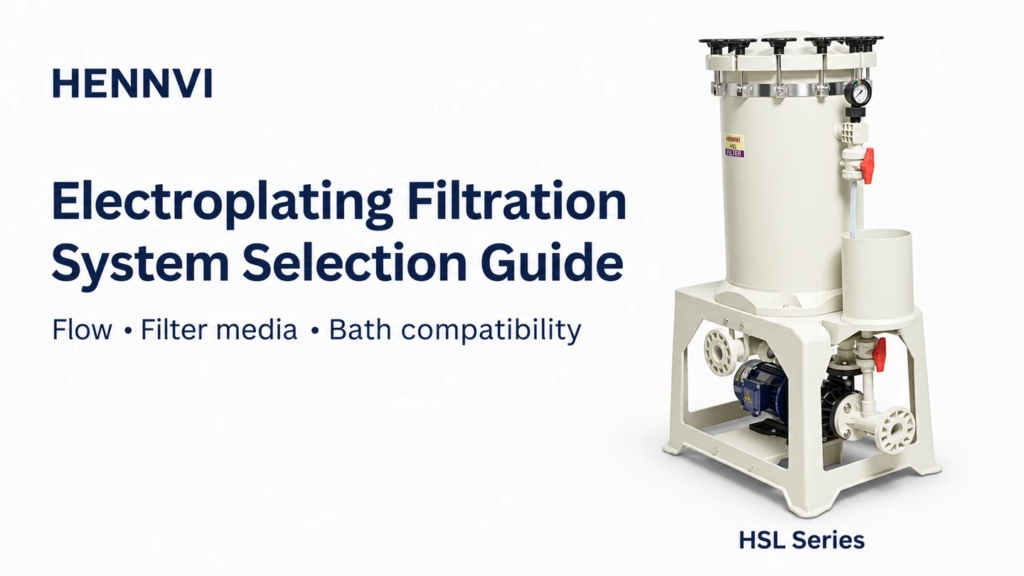
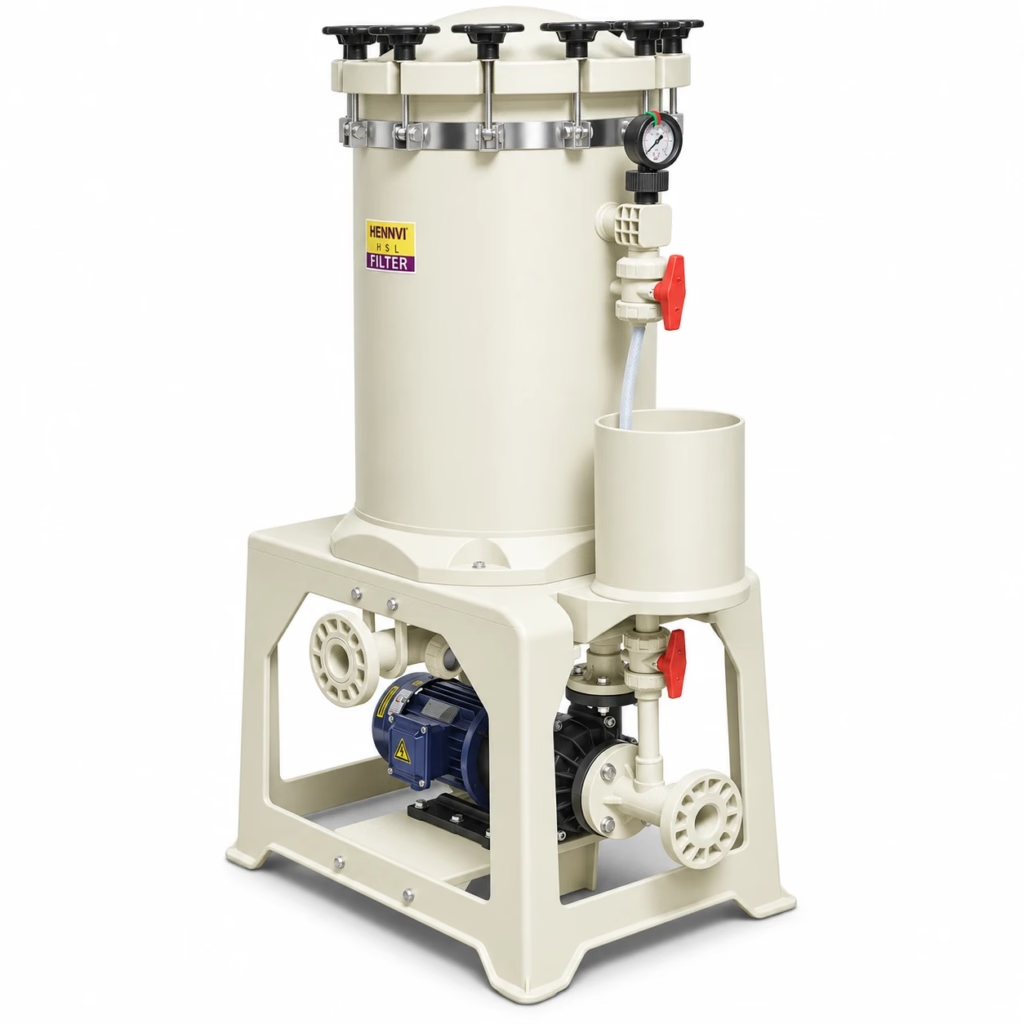
The HSL series integrates a filter chamber and pump on one frame. The supplied configuration should identify the chamber material, pump model, seals and media arrangement for your bath.
2. Calculate Plating Tank Circulation Flow
Use the working solution volume at the normal operating level.
Required flow (L/min) = working bath volume (L) × target turnovers per hour ÷ 60
| Sizing input | Example |
|---|---|
| Working bath volume | 2,000 L |
| Process turnover target | 3 per hour |
| Required hourly circulation | 6,000 L/h |
| Required installed flow | 100 L/min |
Three turnovers per hour is the assumption in this example. Choose the turnover target with the bath chemistry supplier for your process.
Check flow through the filter under the agreed service conditions. Also review the tank suction and return positions so the circulation reaches the areas that need filtration.
3. Check the Complete Pump and Filter Circuit
An electroplating filter pump must deliver the required flow through the tank connections, suction piping, filter media, valves and return line. Have the supplier assess the clean-filter condition and the loaded-filter condition at the agreed changeout point.An electroplating filter pump must provide the required flow through the complete circuit. Ask the supplier to assess the piping, fittings, filter chamber, selected media, and return arrangement together.
Do not choose solely from a pump’s maximum flow figure. Filter media, viscosity, solids loading, and pressure drop influence the flow that a filtration assembly can deliver. Chamber pressure limits also depend on its construction and operating temperature.
For the example above, the useful selection question is: can the proposed assembly maintain the required 100 L/min under the agreed operating and filter-service conditions? That is more informative than asking whether its catalogue flow exceeds 100 L/min.
The Hydraulic Institute explains how pump curves relate flow to head, efficiency, input power and required NPSH. Review these characteristics when confirming the pump for the proposed filtration circuit. Hydraulic Institute pump curve guidance

Conceptual flow sequence. Pipe routing and port positions depend on the supplied assembly.
For the 100 L/min example, request the total head required at that flow and the pump curve for the quoted pump, speed and impeller configuration. Confirm absorbed power across the expected operating range and the chamber’s allowable pressure at the bath temperature.
The gauge shown on the HSL product image measures pressure at its connection. To assess pressure drop across the filter, agree on inlet and outlet measurement points with the supplier and record flow as well as pressure during operation. Use the agreed changeout criteria for the media and equipment.
For help preparing the duty point, see chemical circulation pump head calculation.
4. Select Filter Media and Micron Rating
For cartridge filtration, confirm the required particle retention, cartridge construction, length, end fitting and sealing method. Ask how the micron rating is defined and request the clean pressure-drop information at the intended flow.
The HSL catalogue includes cartridge, cloth, paper and bag arrangements, depending on the configuration. Specify the required internal arrangement when requesting a quote so that the chamber, supports and seals suit the selected media.
Filter flow depends on cartridge construction and length, solids content, liquid viscosity and pressure drop. Chamber pressure limits also depend on operating temperature, so these conditions should be reviewed together during selection. SERFILCO filter chamber technical guidance
| Process requirement | What to confirm |
|---|---|
| Required particle retention | Micron rating, retention efficiency and compatibility with the bath |
| Maintaining circulation | Media pressure drop at the required flow and the agreed loading limit |
| Frequent cartridge changes | Solids load, available filter area and suitability of the media |
| Particles after a change | Cartridge fit, support condition and seal seating |
| Carbon treatment | Approved treatment method, flow and retention of carbon fines |
For further checks, read the electroplating filter cartridge micron rating guide and cartridge bypass checks after replacement.
5. Compare HENNVI HSL Models and Filter Area
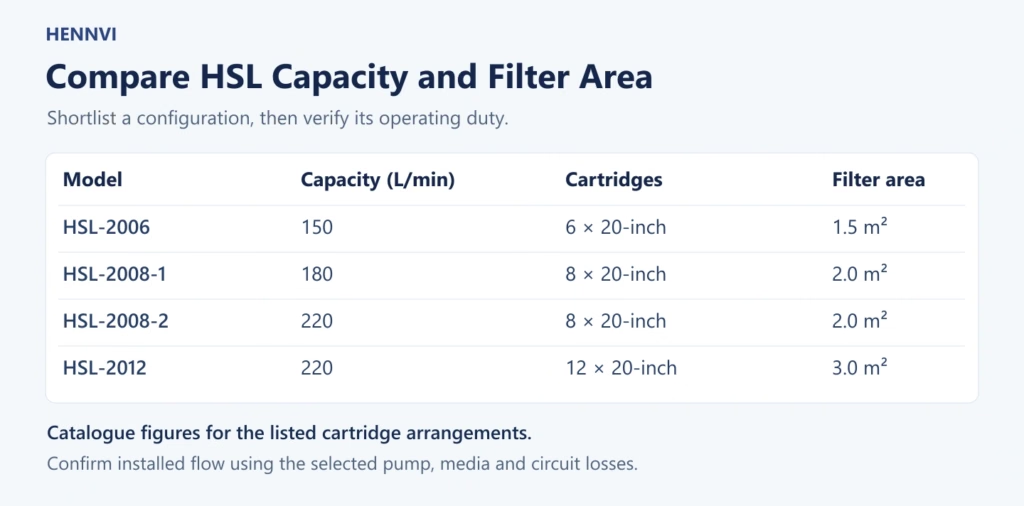
The following catalogue figures apply to the listed HSL cartridge arrangements. Use them to shortlist equipment before confirming performance in your circuit.
| HSL model | Catalogue filtering capacity | Cartridge arrangement | Catalogue filter area |
|---|---|---|---|
| HSL-2006 | 150 L/min | Six 20-inch cartridges | 1.5 m² |
| HSL-2008-1 | 180 L/min | Eight 20-inch cartridges | 2.0 m² |
| HSL-2008-2 | 220 L/min | Eight 20-inch cartridges | 2.0 m² |
| HSL-2012 | 220 L/min | Twelve 20-inch cartridges | 3.0 m² |
The HSL-2006 is a candidate for the 100 L/min example. Ask HENNVI to verify the installed flow with the proposed media and pump at the calculated head.
The HSL-2008-2 and HSL-2012 list the same filtering capacity but different filter areas. At an equal total flow, the larger listed area reduces average flow per unit area. The effect on pressure drop and service interval still depends on the media, solids load and bath properties.
When comparing filtration systems, consider the sustained flow, available pressure and dirt-holding capacity together. These factors influence how effectively the system maintains circulation between service intervals. SERFILCO technical paper on plating solution filtration
Review the HENNVI HSL series specifications and request the complete ordering code. The catalogue identifies HKB and HM pump options. Confirm the selected pump and its electrical rating, including voltage, phase and frequency, on the quotation.
6. Confirm Materials, Limits and Service Access
The HSL catalogue lists PP, CPVC and PVDF chamber material options. Confirm compatibility for the complete wetted assembly, including pump parts, seals, fittings and filter media, using the actual bath concentration, temperature and cleaning liquids.
Request the permitted pressure and temperature for the supplied configuration. Arrange space above the chamber to remove the lid and cartridges, and include access to the valves, gauge and pump in the installation plan.
Before purchase, agree on replacement element specifications, cleaning or changeout procedures and the flow or pressure criteria for service.
Request an HSL Filtration System Quote
Send HENNVI your bath composition and concentration, working volume, operating temperature, required circulation flow and particle retention requirement. Include a piping sketch, site power supply and your available maintenance window.
For an existing installation, add the filter model, cartridge specification, pump and motor nameplate photos, and available flow and pressure readings.
Request a plating filtration selection and quotation. Ask for the pump, chamber material, media arrangement and operating limits, with the expected installed flow at your duty point.
Need a Reliable Pump Solution for Corrosive Applications?
Hennvi Pump provides engineered chemical pump solutions including magnetic drive pumps, diaphragm pumps,centrifugal pumps, dosing pumps,vertical pumps and filtration systems for industrial applications. Share your working conditions and requirements with us. Our technical team will provide professional suggestions, datasheets and competitive pricing for your fluid‑handling solution.