
Magnetic Drive Pump Dry Running Causes and Prevention
Get Product Catalog & Support
Fill out the form to get full specs and case studies.
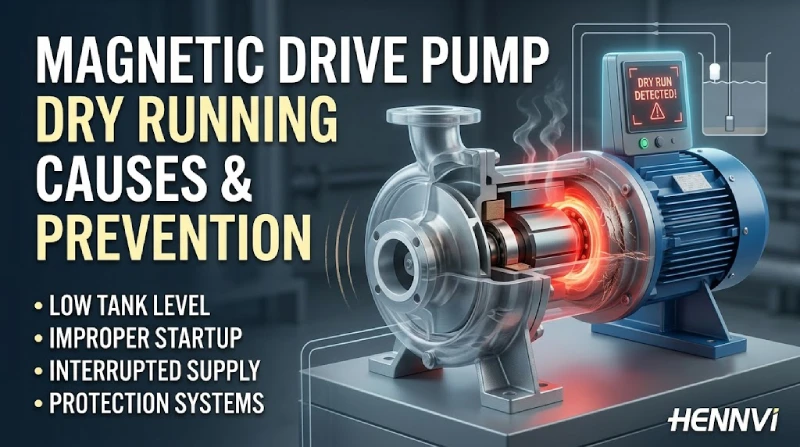
A magnetic drive pump can remove the need for a conventional mechanical shaft seal, but reliable chemical transfer still depends on how the pump is installed and operated. One condition that deserves particular attention is dry running.
An empty supply tank or an incorrectly prepared startup can leave a pump operating without the liquid it needs. For maintenance teams, the practical questions are straightforward: what causes dry running, how can it be detected, and does a dry-running-resistant design remove the need for protection?
This guide explains the checks to make when specifying and operating a magnetic drive chemical pump for transfer or circulation duties.
Table of Contents
ToggleWhat Is Magnetic Drive Pump Dry Running
Dry running means that a pump operates without liquid in its pumping chamber. A related problem is inadequate liquid supply to the internal components that need cooling or lubrication. The motor may continue turning even when useful chemical transfer has stopped.
In many magnetic drive designs, the pumped liquid helps lubricate internal bearings and carry away frictional heat. Losing that liquid can damage components. The outcome depends on the bearing arrangement, materials, temperature, and duration of the event.
Removing a dynamic shaft seal does not remove every maintenance requirement. The casing, static seals, bearings, and connections still need appropriate selection and inspection.
Common Causes to Check
The supply tank reaches a low level
Batch transfer can continue after the usable tank volume has been emptied. In circulation systems, changes in liquid level can also affect the supply to the pump. Include the lowest expected operating level when reviewing the installation, rather than checking only the normal level.
The pump is not prepared correctly before startup
After installation or maintenance, confirm the filling and venting procedure in the model’s operating instructions. Do not assume that a standard magnetic drive pump will draw liquid into an empty casing simply because its motor is running. Self-priming capability is a separate design feature, and self-priming pumps also have specific preparation requirements.
Liquid supply is interrupted
A closed suction valve, a blocked inlet, or a fault in the supply arrangement can interrupt transfer. These conditions require investigation even if the tank still contains liquid. Include valve positions and the condition of inlet equipment in startup and maintenance checks.
Dry Running Cavitation and Deadheading Require Different Checks
These faults can all affect reliability, but they should not be treated as the same event.
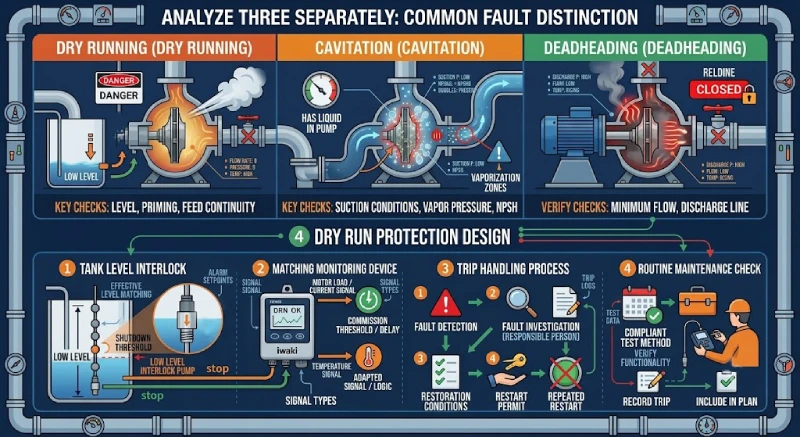
Dry running concerns the absence of liquid. Investigate tank level, filling, and continuity of supply.
Cavitation concerns vapor formation when local pressure becomes too low for the liquid at its operating temperature. Investigate suction conditions, vapor pressure, and the NPSH margin at the required duty point. A pump can contain liquid and still experience cavitation.
Deadheading occurs when the pump runs against a closed discharge or otherwise has insufficient discharge flow. Liquid can remain in the casing while heat builds up. Check the manufacturer’s minimum-flow requirements and the discharge arrangement.
Identifying the actual fault helps determine which operating change or protection device is needed.
How to Plan Dry Run Protection
Use a tank level interlock where appropriate
A low-level switch can prevent startup or stop transfer before the liquid supply is lost. Its position should reflect the usable tank level and suction arrangement. Allow for process fluctuations when setting the stop point.
Consider a suitable pump operating monitor
Pump protection can also use motor load and other operating signals to identify abnormal conditions. IWAKI’s DRN protector, for example, is designed to detect dry running and overload and supports current, temperature, and other inputs.
For your installation, ask which signals are suitable and how they will trigger a pump stop. Set thresholds and delays during commissioning against the actual pump duty. A generic setting may not distinguish normal process changes from a supply fault.
Define what happens after a trip
A protection trip should prompt investigation. Establish who checks the cause, which conditions must be restored, and when restart is permitted. Repeated automatic restarts can recreate the same fault if the tank remains empty or the supply problem has not been corrected.
Check protection during routine maintenance
Include level sensors, alarms, and shutdown functions in the maintenance plan. Verify their operation using an approved test method that does not intentionally expose the pump to damaging conditions. Keep a record of trips so recurring process problems can be addressed.
Can a Magnetic Drive Pump Run Dry
Some magnetic drive pumps have features that improve tolerance to dry running. That capability is specific to the design and configuration.
Finish Thompson states that certain sealless plastic pumps can tolerate extended dry running when equipped with a carbon bushing. IWAKI describes a non-contact structure on specified MX models that reduces heat generation during abnormal operation, with model exceptions. These examples show why buyers should check the exact configuration rather than assume the same capability across a product family.
Before selecting a dry-running-resistant magnetic drive pump, request confirmation of the applicable model, bearing materials, test conditions, permitted duration, and restart procedure. A resistance claim should also be assessed separately from chemical compatibility and the required flow and head.
Need a Reliable Pump Solution for Corrosive Applications?
Hennvi Pump provides engineered chemical pump solutions including magnetic drive pumps, diaphragm pumps,centrifugal pumps, dosing pumps,vertical pumps and filtration systems for industrial applications. Share your working conditions and requirements with us. Our technical team will provide professional suggestions, datasheets and competitive pricing for your fluid‑handling solution.
Hennvi Magnetic Drive Pump Options
Our product catalogue includes HMX and HM sealless magnetic drive pumps, HMD magnetic drive pumps, and HKX high-pressure magnetic pumps.
The catalogue describes dry-running-resistant design features for the HMD and HKX series. For an application where liquid supply may occasionally be interrupted, these series are worth discussing during selection. The catalogue description does not establish a universal allowable dry-running duration for every configuration, so confirm the limits for the proposed model before operation.
Material options also vary by series and configuration. The catalogue lists polymer choices and different shaft, bearing, and elastomer materials. Selection should consider every wetted component against the chemical name, concentration, and temperature.
If your process involves emptying a batch tank, frequent starts, or changing liquid levels, include those details in your enquiry. They help identify both a suitable pump and the protection the installation needs.
Information to Include in a Pump Enquiry
Provide the chemical name and concentration, normal and maximum temperature, density and viscosity, and any solids or crystallization concerns. Include the required flow and head at the same duty point, motor supply, and operating schedule.
For dry run protection, also describe the tank level range, pump position, suction piping, existing interlocks, and the event you are trying to prevent. Explain whether supply interruptions are foreseeable and how the system currently responds to them.
This gives the supplier a useful basis for assessing the pump configuration and operating limits instead of selecting from maximum catalogue values alone.
Conclusion
Preventing magnetic drive pump dry running starts with a dependable liquid supply, correct startup preparation, and protection matched to the process. Dry-running-resistant designs can add tolerance to abnormal operation, but their limits need to be confirmed for the selected model.
For chemical transfer and circulation applications, evaluate chemical compatibility, hydraulic performance, and dry run protection together.
Discuss Your Chemical Pump Application With Hennvi
Looking for a magnetic drive pump for chemical transfer or circulation? Send Hennvi your chemical details, temperature, required flow and head, and suction conditions. If interrupted liquid supply is a concern, include your tank operating cycle and protection requirements so we can discuss a suitable configuration.