
PP vs PVDF Chemical Pumps How to Choose the Right Material
Get Product Catalog & Support
Fill out the form to get full specs and case studies.
When comparing a polypropylene chemical pump with a PVDF model, start with the liquid and its operating conditions. Both materials are used in corrosive chemical service, but neither is suitable for every application.
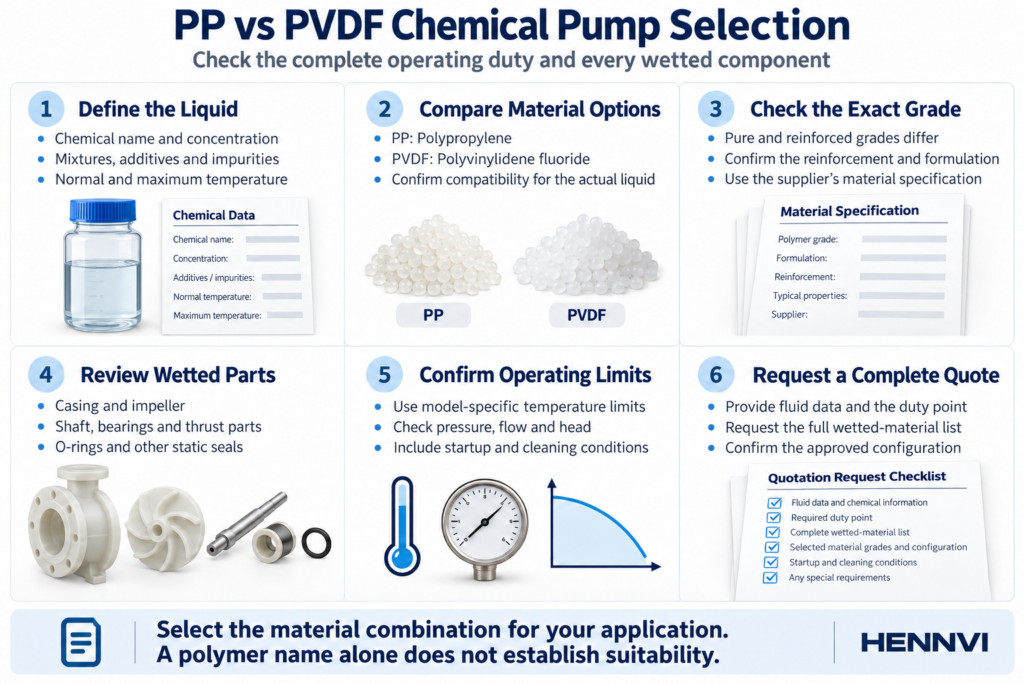
A useful material selection must identify the chemical concentration, temperature range, and complete combination of wetted parts. The casing material is only one part of that decision.
This guide explains how to compare PP and PVDF chemical pumps, what reinforced material names mean, and which information to provide when requesting a Hennvi pump quotation.
Table of Contents
ToggleWhat Is the Difference Between PP and PVDF
PP stands for polypropylene, a thermoplastic used in chemical piping, fittings, and pumps. It resists many corrosive liquids and is a candidate for numerous chemical transfer and circulation duties when compatibility is confirmed.
PVDF stands for polyvinylidene fluoride, a fluoropolymer used where its chemical resistance and other material properties suit the process. It is also available in chemical pump construction.
The practical comparison is not simply which polymer has a stronger general reputation. It is whether the proposed material remains suitable for the specific chemical at the concentration and temperature your process will reach.
Compare the Conditions That Affect Selection
Selection factor | What to check for a PP pump | What to check for a PVDF pump |
Chemical compatibility | Exact liquid, concentration, and applicable compatibility data | The same checks; PVDF is not a universal approval |
Temperature | Model-specific operating limits and chemical restrictions | Model-specific limits rather than a generic polymer rating |
Material grade | Pure PP or the specified reinforced compound | Unfilled PVDF or the specified reinforced compound |
Wetted components | Impeller, shaft, bearings, static seals, and other exposed parts | The full component list, including materials other than PVDF |
Purchase comparison | Confirmed configuration and suitability for the duty | Confirmed configuration and the reason for selecting it |
Use this comparison to structure a supplier discussion. It is not a chemical compatibility chart and does not approve either material for a particular liquid.
Start With Chemical Name and Concentration
Descriptions such as “acid solution,” “alkaline cleaner,” or “plating liquid” are too broad for a final material recommendation. Provide the chemical name, concentration, and any relevant additives or contaminants. For a proprietary formulation, supply the available composition information and technical documentation to the pump supplier.
Compatibility charts help narrow the options, but their conditions matter. DEBEM, for example, identifies temperature qualifications in its compatibility information and notes that its reference table concerns pure PP and PVDF. It also explains that glass or carbon additives in actual pump materials may influence compatibility.
If your process changes concentration during operation, describe the range. Ask for the supplier’s assessment of the proposed configuration across that range rather than accepting a recommendation based on a single nominal value.
Check the Pump Temperature Rating
A material’s general temperature capability is not the same as the operating limit of a complete pump. Pump construction, internal components, and the liquid being handled must also be considered.
Finish Thompson’s DB and SP brochure, for example, lists maximum temperatures of 82°C for polypropylene and 104°C for PVDF. Those figures apply to that manufacturer’s specified products; they are not Hennvi ratings or universal limits for PP and PVDF pumps.
Include normal and maximum liquid temperatures in your enquiry. Also identify any different temperatures encountered during cleaning or startup. Request the permitted operating conditions for the exact model and material combination offered.
Understand PP FRPP and CFRPP Designations
Material labels should be read carefully. A reinforced polypropylene compound is not identical to pure polypropylene. The reinforcement and its exposure to the process liquid need to be considered in the supplier’s compatibility assessment.
IWAKI’s MD series, for example, uses glass-fiber-reinforced polypropylene wet ends. Hennvi’s HMX catalogue lists PP and CFRPP separately, alongside PVDF and CFRETFE options. These product descriptions show why “plastic chemical pump” is not a sufficiently detailed material specification.
When comparing quotations, request the exact material designation and the components to which it applies. Avoid treating different reinforced compounds as interchangeable simply because they share the same base polymer.
Review Every Wetted Component
A PVDF magnetic drive pump may contain wetted components made from other materials. Bearings, shafts, thrust parts, and O-rings all need review.
Finish Thompson’s construction tables illustrate this by listing housing materials separately from shafts, bushings, and seals. Hennvi’s HMX model description follows a similar principle: the pump material, shaft material, bearing material, and rubber material have separate selections.
Ask for a complete wetted-material list with the quotation. Confirm that replacement parts will preserve the approved combination. Ordering only by the casing material can leave important details unresolved, particularly when an existing installation has been modified or repaired.
Need a Reliable Pump Solution for Corrosive Applications?
Hennvi Pump provides engineered chemical pump solutions including magnetic drive pumps, diaphragm pumps,centrifugal pumps, dosing pumps,vertical pumps and filtration systems for industrial applications. Share your working conditions and requirements with us. Our technical team will provide professional suggestions, datasheets and competitive pricing for your fluid‑handling solution.
Hennvi Material Options for Chemical Transfer
The Hennvi English catalogue lists the following HMX pump material options: PP, CFRPP, PVDF, and CFRETFE. It also lists ceramic or silicon carbide shaft options, several bearing materials, and elastomer choices including Viton and EPDM.
These are configuration options, not a statement that every combination suits every chemical. Availability and compatibility should be confirmed for the selected model.
For a routine transfer or circulation duty, ask Hennvi to evaluate the available material combinations against your liquid data. If an existing pump has experienced chemical attack, include the failed component and operating history in the enquiry. That information makes the discussion more useful than requesting a casing upgrade alone.
Prepare a Complete Material Selection Enquiry
Before requesting a quotation, gather the following information:
– Chemical name, concentration range, and relevant mixture details.
– Normal and maximum liquid temperatures, including cleaning conditions.
– Required flow and head at the same operating point.
– Density, viscosity, and any solids or crystallization concerns.
– Operating schedule, suction arrangement, and installation conditions.
– Existing pump materials and the reason for replacement, if applicable.
Then ask the supplier to identify the proposed wetted materials and confirm the applicable operating limits. When comparing a PP and a PVDF proposal, keep the duty and scope of supply consistent so that the material choice can be assessed clearly.
Conclusion
Choosing between PP and PVDF chemical pumps requires a review of the actual chemical, temperature, material grade, and complete wetted assembly. A polymer name alone does not establish suitability.
Define the operating conditions first, then select a pump configuration supported by the supplier’s compatibility assessment and model-specific limits.
Discuss Your Chemical Pump Materials With Hennvi
Need help comparing a polypropylene chemical pump with a PVDF option? Send Hennvi your chemical name, concentration, temperature range, required flow, and head. Our team can discuss the available pump configurations and the material details that need to be confirmed for your application.