
How to Choose an Electroplating Filter Cartridge Micron Rating

Get Product Catalog & Support
Fill out the form to get full specs and case studies.
When a plating bath shows visible particles or parts start coming out with a rough finish, switching to a finer cartridge can seem like the quickest fix. Before changing the electroplating filter cartridge micron rating, check which particles you need to capture and how much circulation the bath needs throughout a production run.
A finer element may capture smaller particles. It may also load sooner, depending on its construction, available filter area and the amount of solids in the bath. The right selection provides the required particle retention while maintaining the flow the process needs. SERFILCO guidance on nickel solution filtration
Table of Contents
ToggleWhat Does a Cartridge’s Micron Rating Tell You?
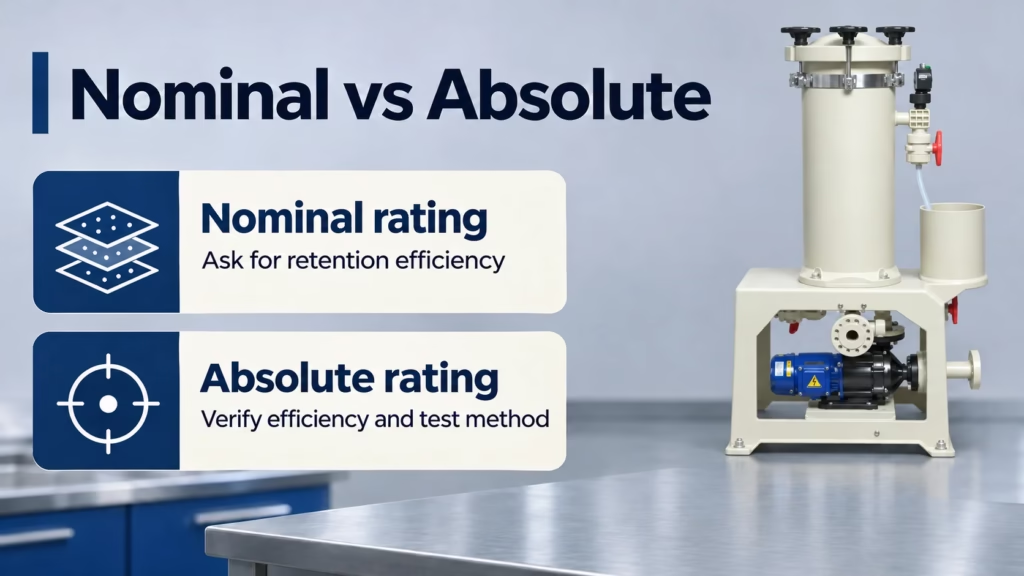
A micron rating identifies a particle size associated with the cartridge’s retention performance. To compare two cartridges, ask how efficiently each one captures particles at the stated size and how that performance was tested.
| Specification | What to ask the supplier |
|---|---|
| Nominal micron rating | What percentage of particles at the stated size does the cartridge retain under the supplier’s test conditions? |
| Absolute micron rating | What retention efficiency and test method support the stated rating? |
| Clean pressure drop | What is the pressure drop at the flow we need, and what liquid and temperature were used for the test? |
| Cartridge construction | What are the media, core, end caps and sealing materials? |
Two cartridges marked 10 µm can have different retention efficiencies and different resistance to flow. Compare the manufacturer’s performance data alongside the label. Eaton industrial process filter cartridge specifications
Should You Choose a 5, 10 or 20 Micron Filter for Electroplating?
There is no single micron rating for every plating bath. Start with the particles observed in the bath, the finish requirement, the solids load and the circulation flow. A bath with a heavy load of coarse particles may benefit from removing those particles first. A process with a stricter finish requirement may need finer filtration once the bulk solids are under control.
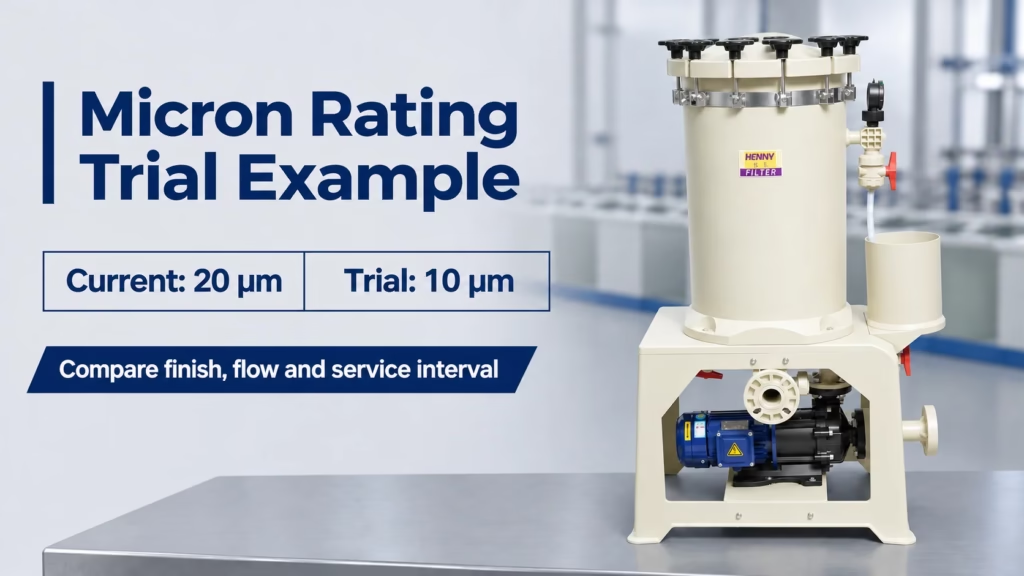
Suppose an existing 20 µm cartridge maintains circulation, but inspection shows that smaller suspended particles are reaching the workpieces. A 10 µm cartridge is a reasonable trial candidate if its retention data addresses those particles. Compare the finish, return flow and service interval over similar production runs. If flow drops too quickly, review the available filter area and solids load before moving to a still finer element.
When comparing pressure drop readings, take them at comparable flow and bath temperature where possible. A clean-cartridge baseline gives you a reference for seeing how resistance increases during service. Use the cartridge and housing limits for the installed configuration when setting a changeout criterion.
How to Match a Cartridge to the HENNVI HSL System
HENNVI’s HSL Series supports recirculating chemical filtration and lists 10-inch, 20-inch and 30-inch cartridge configurations across the range. Cartridge length describes physical fit. Micron rating describes particle retention. Confirm both for the exact HSL model before ordering replacements. HENNVI HSL Series chemical filtration system
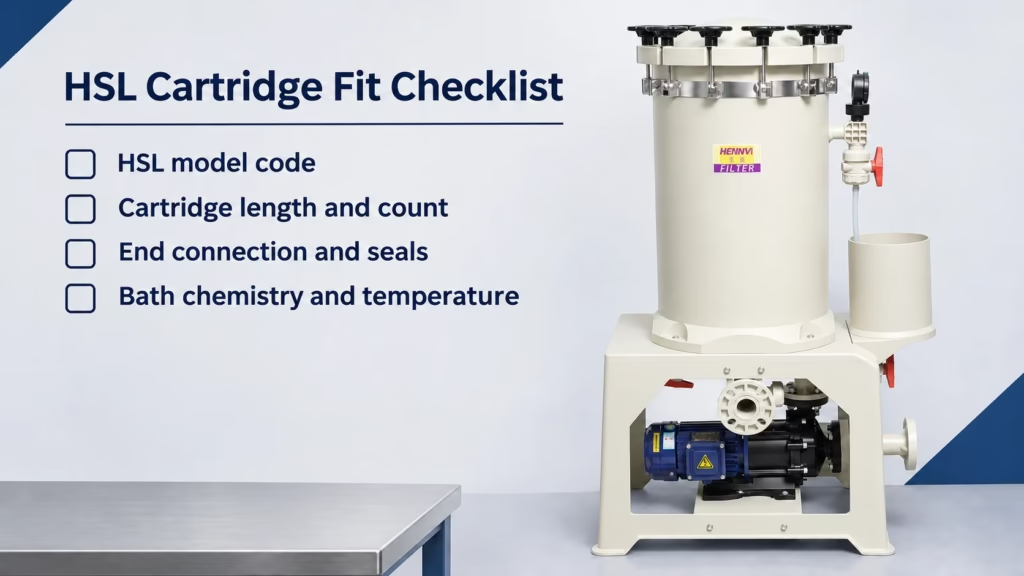
For an existing HSL unit, send the model code and the current cartridge specification. Include the cartridge count, length, end connection and seal type if available. Ask HENNVI to check the compatibility of the media, core and seals with the bath chemistry and temperature. If you are changing the micron rating, provide the required return flow and any pressure readings taken with clean and used cartridges.
Frequently Asked Questions
Is a lower micron rating always better for a plating bath?
Choose the rating that meets the particle retention requirement while maintaining circulation through the production run. A finer rating is useful when it captures particles relevant to the finish and the system can sustain the resulting pressure drop.
Can I replace a nominal 10 µm cartridge with an absolute 10 µm cartridge?
Compare retention efficiency, clean pressure drop, chemical compatibility and physical fit before replacing it. The two cartridges can behave differently even when both are labelled 10 µm.
Can I put a 20-inch cartridge in an HSL unit that uses 10-inch elements?
Check the housing and internal supports for the exact HSL model. The replacement cartridge must match the specified length, end connection and sealing arrangement.
Request an HSL Cartridge Selection from HENNVI
Send your HSL model, bath chemistry and temperature, current cartridge rating and length, required circulation flow, and typical service interval. If you are trying to solve a finish defect or rapid clogging, describe when it appears and include any available pressure readings. These details give HENNVI a basis for reviewing the micron rating, cartridge construction and fit together.
Need a Reliable Pump Solution for Corrosive Applications?
Hennvi Pump provides engineered chemical pump solutions including magnetic drive pumps, diaphragm pumps,centrifugal pumps, dosing pumps,vertical pumps and filtration systems for industrial applications. Share your working conditions and requirements with us. Our technical team will provide professional suggestions, datasheets and competitive pricing for your fluid‑handling solution.