
Chemical Filter Air Lock After a Cartridge Change on an HSL System
Get Product Catalog & Support
Fill out the form to get full specs and case studies.
If the return to your plating tank starts pulsing shortly after a cartridge change, pay attention to what happens in the first few minutes. A return that surges, fades, and then picks up again gives you a different clue from a return that stays weak throughout the run. Pressure readings, bath level, and the timing of the change can help you decide whether to check for trapped air, a restriction, or cartridge bypass.
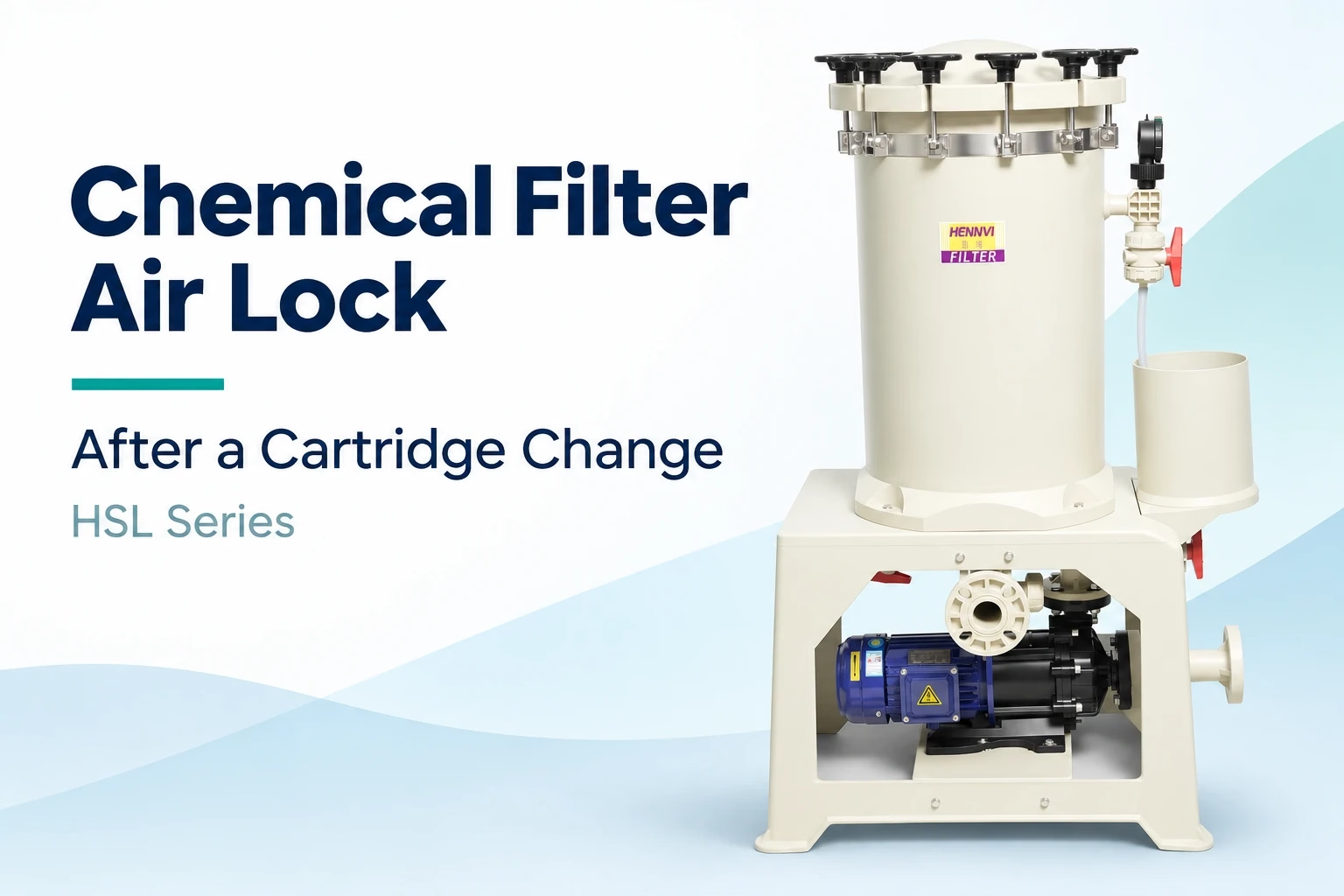
The HENNVI HSL is an integrated chemical filtration system for recirculating process liquids, including electroplating solutions. This guide focuses on HSL configurations that use cartridges. Keep the full model code and the instructions for the installed unit handy when checking the cartridge assembly, fill path, and vent arrangement. HENNVI HSL Series Integrated Chemical Filtration System
Table of Contents
ToggleWhy Chemical Filter Air Lock Can Occur After a Cartridge Change
When troubleshooting chemical filter air lock on an HSL system, compare return flow, pressure behavior, and the appearance of the returning liquid.
Opening a filter chamber for service gives air a way into the system. During refilling, some air can remain in the chamber or collect at a high point in the connecting piping. The location matters. On the suction side, air can disturb the liquid supply to the pump and cause pressure to fluctuate. On the discharge side, a pocket of air can reduce the area available for liquid flow. Either condition can show up as an uneven return to the tank. Hydraulic Institute guidance on air pockets in pump piping
The first question is when did the return become unstable? If it happened on the first restart after the housing was opened, review the refill and air-removal checks. If the return was steady at first and became unstable later, record the bath level at the time of the change. A repeat problem at low level can point to air entering near the suction inlet. Confirming when the symptom starts gives you a better lead than judging the pump by sound alone. Hydraulic Institute guidance on pump suction conditions
How to Tell Air Lock, Restriction, and Bypass Apart
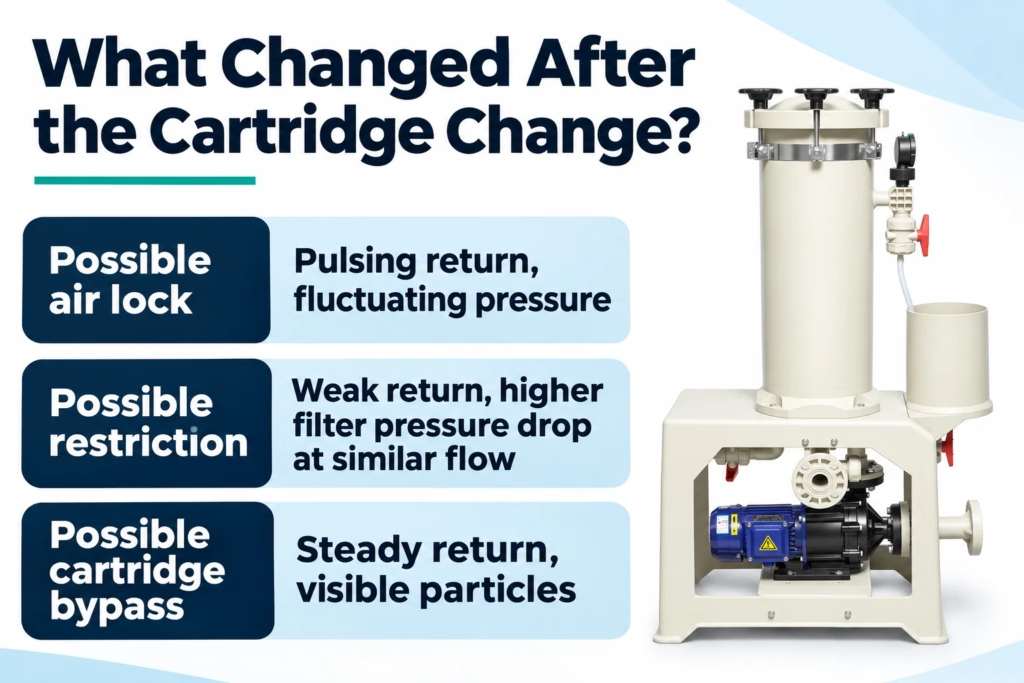
Look at three things together: return flow, pressure behavior, and the appearance of the returning liquid. Use the observations below to choose the next check.
| What you observe | Likely issue to investigate | What to check |
|---|---|---|
| The return pulses after service, and the pressure reading rises and falls. | Trapped air or air entering the loop | Review the approved fill and vent process. Check the bath level, suction conditions, and any high points on the piping layout. |
| The return stays weak after the system is filled, and the pressure drop across the filter is higher than the clean baseline at comparable flow. | A restriction through the filter | Verify the cartridge specification and look for an obstruction on the path between the two pressure measurement points. |
| The return stays weak, and only the upstream gauge reads high. | A restriction somewhere downstream of the gauge | Verify the valve positions and return path. Use approved readings on both sides of the filter to determine how much of the pressure drop is across the housing. |
| The return appears steady, but visible particles remain after the cartridge change. | Possible cartridge bypass or another source of particles | Check cartridge end style, seating, and sealing. Compare samples from the same location after circulation stabilizes. |
A single gauge reports pressure where it is installed. Filter differential pressure is the upstream reading minus the downstream reading, taken at the appropriate points. Compare readings at similar flow, bath temperature, and valve positions. If your HSL installation has one gauge, record its location and reading together with the return flow. Electroplating filter low-flow checks
What to Verify on Your HSL Model Before Restart
Start with the cartridges that went into the housing. Confirm the length, count, end style, micron rating, and media against the full model code and the configuration ordered for the unit. Maintenance should follow the installed unit’s service instructions and the plant’s chemical-handling procedure. Isolate the housing and verify that pressure has been relieved before opening it for inspection.
The HSL specification table shows why the model matters. In the listed B/C cartridge configurations, the HSL-2006 uses six 20-inch cartridges and has a listed filtering capacity of 150 L/min. The HSL-2012 uses twelve 20-inch cartridges and has a listed capacity of 220 L/min. Both use the same nominal cartridge length in these configurations, while their cartridge counts and listed capacities differ. Check the installed configuration when ordering replacements. For troubleshooting, compare the measured return flow with that same unit’s clean-filter record under comparable conditions. HENNVI HSL model identification and specifications
Before returning the unit to service, verify the intended circulation path. Check the bath level, suction supply, and positions of the inlet, outlet, and any bypass valves fitted to the loop. Follow the approved fill and vent procedure for that installation. If circulation fails to establish or the pump runs abnormally, follow the site shutdown procedure before investigating further.
Three Common Situations After a Cartridge Change
The return pulses on the first restart, then settles
If the return becomes steady after the approved air-removal procedure, trapped air may have contributed to the problem. Record how long it took for the return and pressure readings to stabilize. That gives the next shift a reference if the symptom occurs again.
The return settles, then pulses again as the bath level falls
Record the liquid level when the symptom comes back. Check whether the suction inlet remains adequately submerged and whether a surface vortex or a suction-side connection could be introducing air. If the symptom follows the bath level across several runs, that pattern is useful when reviewing the piping layout. Hydraulic Institute guidance on submergence and air entry
The return is steady, but the liquid still looks cloudy
Observe whether visible bubbles clear once circulation stabilizes. If particles remain, review the cartridge installation and compare the replacement with the previous cartridge. Pay particular attention to end style, length, and seating. A finer micron rating addresses particle size, while correct seating ensures the liquid passes through the media. Electroplating filter cartridge bypass checks
Record a Clean-Filter Baseline for the Next Shift
Once the HSL is back at stable circulation with clean cartridges, record the operating conditions that another technician can reproduce:
- Equipment and media — full HSL model code, cartridge length and count, end style, and micron rating.
- Bath conditions — liquid level, temperature, and any recent changes to the process or cleaning chemistry.
- Flow — measured return flow if a meter is available, or a note describing the return as steady, intermittent, or weak.
- Pressure — each reading and its measurement location, together with the valve positions at the time.
- Timing — when circulation stabilized, and whether bubbles or particles were still visible.
Use the same measurement points when comparing the next run. A pressure value recorded with a partly closed valve or a different pump speed is a poor baseline for the normal operating configuration. Keeping the reading and the operating conditions together makes the record useful.

Frequently Asked Questions
Does a fluctuating pressure gauge prove the filter is air-locked?
A fluctuating reading is a clue. Check whether it coincides with a pulsing return and whether both started after the housing was opened. If the return is steady while the gauge continues to fluctuate, include the gauge and its measurement point in the review.
Should I use a finer cartridge if the bath remains cloudy?
First check the replacement cartridge’s fit and whether the cloudiness persists after circulation stabilizes. If particles are passing around poorly seated cartridge ends, the seating problem needs to be corrected before a different micron rating can be evaluated. HENNVI guide to cartridge micron ratings
What should I send HENNVI if the HSL still has unstable flow?
Send the HSL nameplate photo, cartridge specifications, bath chemistry and temperature, and pressure readings with gauge locations. Include a simple sketch of the tank, pump, filter, and return line. Note whether the issue starts immediately after a cartridge change or only after the bath level drops. That timing helps HENNVI identify which part of the loop to review first. Contact HENNVI about your HSL filtration system
Need a Reliable Pump Solution for Corrosive Applications?
Hennvi Pump provides engineered chemical pump solutions including magnetic drive pumps, diaphragm pumps,centrifugal pumps, dosing pumps,vertical pumps and filtration systems for industrial applications. Share your working conditions and requirements with us. Our technical team will provide professional suggestions, datasheets and competitive pricing for your fluid‑handling solution.