
Vertical Chemical Pump Installation Dimensions for HUP Tank Mounting

Get Product Catalog & Support
Fill out the form to get full specs and case studies.
Before ordering a tank-mounted HUP pump, check the vertical chemical pump installation dimensions against the tank opening, mounting surface, and discharge piping. Start with the actual mounting plane. Once you know where the pump will sit, you can compare the tank depth, bottom clearance, discharge position, and space needed to lift the pump out for maintenance.
The HENNVI HUP series is a tank-mounted vertical chemical pump with a sealless cantilever design. The product information lists PP and PVDF housing options. Use the dimensional drawing for the exact model and configuration to check the fit of your installation. HENNVI HUP Series Vertical Chemical Pump
Table of Contents
ToggleStart With the Surface That Will Support the Pump
Mark the surface the pump will rest on. Depending on the equipment layout, this could be the tank cover, a support frame, or a separate mounting plate. Measure the tank opening and the depth below that surface. If the tank has a sloped bottom or an internal obstruction, measure at the intended pump location.
Use the same reference point for the dimensions on your field sketch. A tank dimension measured from the rim can be misleading if the pump is supported by a frame above it. On a retrofit, show the height difference between the tank rim and the existing support surface so the supplier can compare your sketch with the pump drawing.
Which Installation Dimensions Should You Check?
| Dimension | What to record | Why it matters |
|---|---|---|
| Tank opening | Clear opening length and width, including any obstructions. | The lower pump assembly needs room to pass through during installation and removal. |
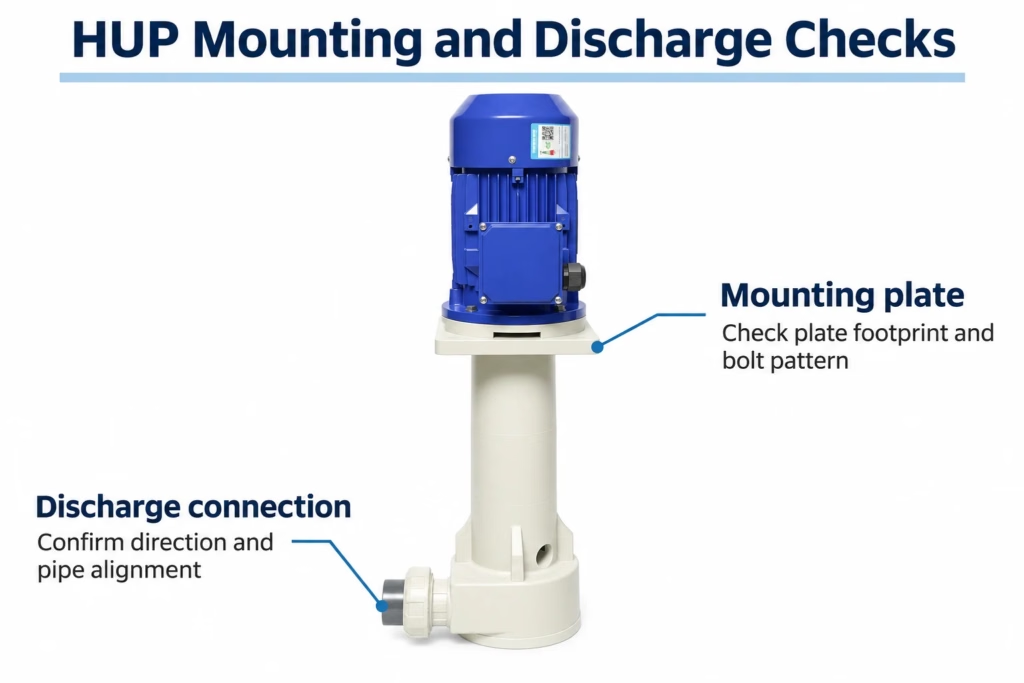
| Mounting plate and fasteners | Available support area, bolt-hole spacing, hole diameter, and the position of the opening relative to the holes. | These dimensions help confirm where the pump will sit and whether the existing frame can be reused. |
| Depth below the mounting plane | Distance from the support surface to the tank bottom or nearest obstruction at the pump location. | This gives the supplier a reference for checking the length of the assembly below the plate and the remaining bottom clearance. |
| Discharge connection | Position, orientation, connection type, and distance from the mounting plane to the mating pipe. | The proposed pump must line up with the intended piping route, or the piping changes must be identified before ordering. |
| Service clearance | Space above and around the motor, including overhead beams, cable trays, and nearby piping. | A pump can fit in the operating position and still be difficult to remove for service. |
Ask the supplier for a drawing that shows the mounting footprint, the assembly below the mounting plane, and the discharge connection. Include your field dimensions on the same reference system wherever possible.
A Worked Example of Checking Bottom Clearance
Suppose the distance from the mounting surface to the tank floor is 500 mm at the pump location. The proposed drawing shows 420 mm from the same mounting plane to the lowest point of the pump assembly. The difference is 80 mm of geometric bottom clearance before checking installation tolerances or obstructions.
These dimensions illustrate the method. Ask HENNVI to confirm the required clearance and installed arrangement for the selected assembly. Also record the lowest liquid level expected while the pump is running. Bottom clearance measures the space below the pump assembly. Inlet submergence depends on where the liquid surface is relative to the inlet. Both should be checked on the installation drawing. HENNVI guide to vertical pump minimum liquid level
Why the Full HUP Model Matters
The HUP specification table gives a practical example. The HUP-32SK-1 and HUP-40SK-1 both list a 1 hp motor. The first lists 50 × 32 mm inlet and outlet diameters, while the second lists 50 × 40 mm. Include the full model code when requesting a dimensional drawing, especially if the discharge pipe has already been built. HENNVI HUP model specifications
If you are replacing another pump, attach photos of the existing support and discharge connection. Record whether the existing pipe, mounting frame, or tank cover must remain. This gives the supplier a way to flag installation changes before the equipment arrives.

What to Send HENNVI for an HUP Installation Review
Send the HUP model or existing nameplate, a sketch showing the mounting plane, tank opening, depth, lowest operating liquid level, and discharge position, and photos of the support frame. Include the liquid, concentration, operating temperature, required flow, and total head so the proposed configuration can be reviewed for both fit and duty. Request an HUP installation review
Need a Reliable Pump Solution for Corrosive Applications?
Hennvi Pump provides engineered chemical pump solutions including magnetic drive pumps, diaphragm pumps,centrifugal pumps, dosing pumps,vertical pumps and filtration systems for industrial applications. Share your working conditions and requirements with us. Our technical team will provide professional suggestions, datasheets and competitive pricing for your fluid‑handling solution.