
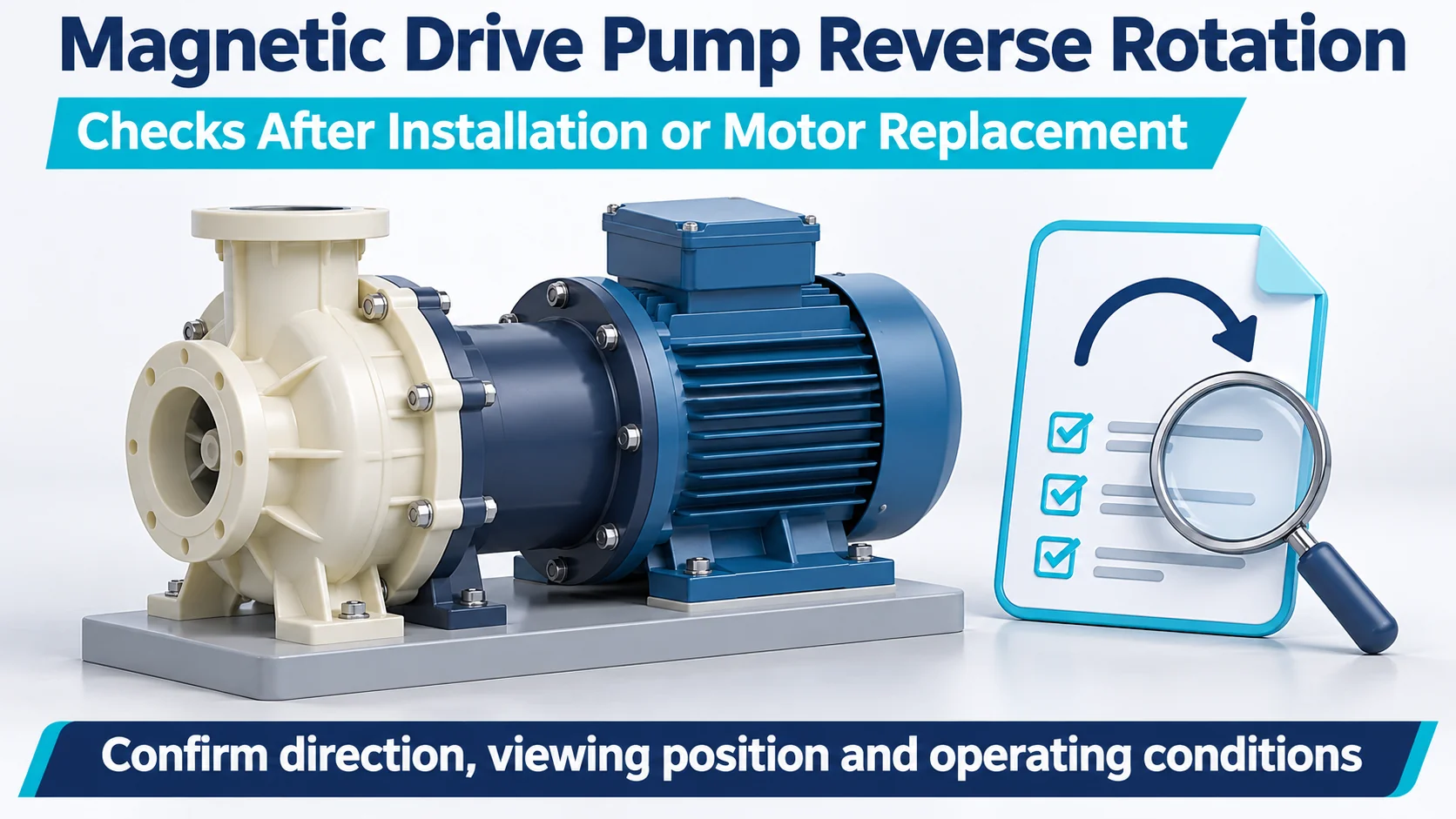
Magnetic Drive Pump Reverse Rotation: Checks After Installation or Motor Replacement
Get Product Catalog & Support
Fill out the form to get full specs and case studies.
A magnetic drive pump develops low flow after installation or motor replacement. The motor runs, the casing is filled, and the pipework appears unchanged.
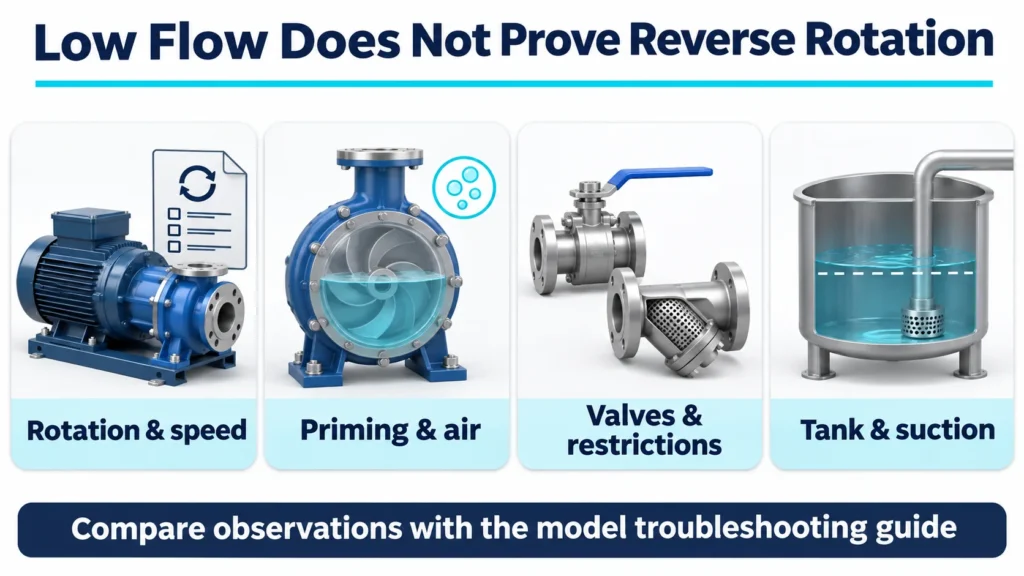
Incorrect rotation is one possible explanation. It should be checked alongside priming, valve positions, speed and suction conditions.
This article explains how to investigate reverse rotation without assuming that every low-flow problem has the same cause.
Table of Contents
ToggleCan a Magnetic Drive Pump Run in Reverse?
Some centrifugal pump designs may still move liquid when rotating in the wrong direction, but their performance can be greatly reduced. Reverse rotation should not be used as an alternative operating mode.
The consequences depend on the pump design. Follow the direction marking and instructions for the exact model. Iwaki’s troubleshooting information identifies reverse rotation among possible causes of poor delivery. Iwaki MDE Instruction Manual
When Should Rotation Be Checked?
Include a direction check in the manufacturer’s commissioning procedure, particularly after work affecting the motor or drive.
Relevant occasions include:
- Initial installation.
- Motor replacement.
- Electrical reconnection.
- Drive replacement or configuration changes.
- Relocation of the equipment.
A useful maintenance record includes the observed direction, viewing position, operating measurements and the person completing the check.
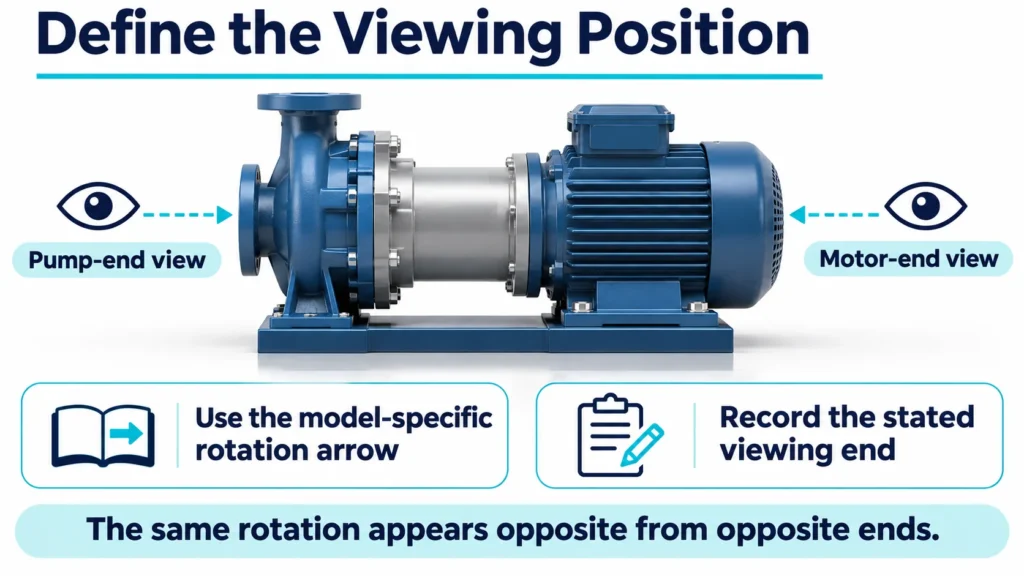
1. Identify the Correct Direction and Viewing Position
Find the rotation arrow and the applicable manual.
“Clockwise” is incomplete unless the viewing position is defined. The same shaft appears to turn in opposite directions when viewed from opposite ends.
Record whether the instruction refers to the motor fan end, pump end or another specified location. Do not copy the direction from a neighbouring pump of a different design.
2. Follow the Model-Specific Check Procedure
Confirm the pump’s required filled and vented condition before any permitted rotation test.
Electrical checks and corrections should be carried out by personnel qualified for that work. Use the motor and drive instructions, including any restrictions on starting or jogging.
Do not apply a generic test duration or wiring instruction to every pump. Iwaki’s MDK manual, for example, places its direction check within a defined preparation procedure after priming. Iwaki MDK Operating Instructions
3. Compare Flow and Pressure with a Baseline
A direction observation is stronger evidence than a symptom alone. Flow and pressure measurements help assess whether the pump has returned to the expected duty.
| Observation | What to investigate |
|---|---|
| Low flow immediately after electrical work | Rotation, speed, priming and valve positions |
| Gradual flow reduction | Filter loading, deposits, changing suction conditions or wear |
| Intermittent delivery | Air ingress, tank level and unstable operating conditions |
| Motor running with little or no delivery | Priming, gas binding, closed flow path, coupling or internal condition |
These observations guide an investigation. They do not establish a diagnosis by themselves.
4. Distinguish Reverse Rotation from Magnetic Decoupling
In reverse rotation, the direction is incorrect.
Magnetic decoupling is a different event: the driving and driven parts lose synchronous motion. A turning motor therefore does not prove that the internal pumping assembly is operating normally.
KSB describes decoupling when the torque to be transmitted exceeds the coupling’s applicable limit. Follow the pump manufacturer’s response procedure rather than repeatedly restarting an unexplained no-flow condition. KSB: Magnetic Coupling

5. Check Other Causes Before Replacing the Pump
If rotation is correct, continue with the model’s troubleshooting guide.
Review:
- Whether the pump is filled and properly vented.
- Tank level and suction connections.
- Valve positions.
- Strainers and filters.
- Actual operating speed.
- Liquid properties.
- Required system head.
- Evidence of internal damage or obstruction.
Manufacturers list several possible causes of insufficient discharge. A low-flow symptom should not lead directly to ordering a larger pump. Iwaki MDE Troubleshooting Guide
Information to Record Before Calling the Supplier
| Information | What to provide |
|---|---|
| Equipment | Pump and motor identification |
| Recent work | Installation, reconnection, motor or drive changes |
| Direction | Observed direction and viewing position |
| Performance | Flow, suction pressure and discharge pressure |
| Operating conditions | Liquid, temperature, tank level and valve positions |
| Electrical data | Nameplate ratings and confirmed operating speed |

Frequently Asked Questions
Does visible liquid movement prove correct rotation?
No. Verify the direction against the model’s marking and instructions.
Does low flow always mean reverse rotation?
No. Priming, suction restrictions, filter resistance, speed and internal condition can produce similar symptoms.
Should I reverse the motor to see whether flow improves?
Use the manufacturer’s direction-check procedure. Do not use trial-and-error operation as the diagnosis.
Is magnetic decoupling the same as reverse rotation?
No. One concerns synchronisation of the magnetic coupling; the other concerns direction.
Discuss a Low-Flow Problem with HENNVI
Send HENNVI the pump model, motor nameplate, recent maintenance history, measured flow and pressures, and the confirmed direction of rotation.
Request a model-specific review before changing the pump size or configuration.
Need a Reliable Pump Solution for Corrosive Applications?
Hennvi Pump provides engineered chemical pump solutions including magnetic drive pumps, diaphragm pumps,centrifugal pumps, dosing pumps,vertical pumps and filtration systems for industrial applications. Share your working conditions and requirements with us. Our technical team will provide professional suggestions, datasheets and competitive pricing for your fluid‑handling solution.