
Magnetic Drive Pump Bearing Materials: What to Check Before Ordering

Get Product Catalog & Support
Fill out the form to get full specs and case studies.
A chemical pump quotation may identify the casing as PP or PVDF while giving little information about the internal bearing system. That leaves an important part of the selection unresolved.
The shaft, bushing and thrust components can use different materials. Their suitability depends on the chemical, operating conditions and the way the components work together.
Before ordering a magnetic drive pump, request the complete wetted-material specification, including the internal support components.
Table of Contents
ToggleWhich Components Are You Comparing?
Start with the parts drawing. “Ceramic bearing” is not a complete description of the assembly.
| Component | Information to request |
|---|---|
| Shaft or spindle | Exact material and part number |
| Bearing or bushing | Material grade and mating surface |
| Thrust components | Material and position in the assembly |
| Internal flow passages | Requirements for cooling and lubrication |
| Replacement assembly | Approved combination of components |
Some designs use different materials for the stationary and rotating parts. Comparing one material name without identifying its location can therefore be misleading.

Alumina, Silicon Carbide and Carbon-Based Materials
Pump catalogues may list alumina ceramic, silicon carbide or carbon-based components. Ask the supplier to identify the exact material rather than treating these descriptions as interchangeable.
Silicon carbide is itself a ceramic. When a catalogue separates “ceramic” from “SiC,” clarify what the first term means.
Iwaki’s technical information discusses ceramic, carbon-based and polymer bearing materials, including their different responses to lubrication loss and heat. These are design considerations, not a universal ranking of materials. Iwaki: Magnetic Drive Pump Technical Information

1. Check Chemical Compatibility for Every Wetted Part
A compatible pump casing does not establish compatibility for the shaft, bushing or seals.
Provide the supplier with:
- Chemical composition and concentration.
- Operating temperature.
- Cleaning liquids.
- Solids or deposits.
- Changes in the liquid during production.
Request confirmation for the complete assembly. Manufacturer resistance tables can distinguish between casing, bearing-unit and O-ring materials rather than assigning one compatibility result to the entire pump. JESS: Magnetic Centrifugal Pump Resistance List
2. Explain the Solids and Deposit Conditions
“Clean liquid” should describe the actual process.
Tell the supplier whether the liquid contains particles, can crystallise during shutdown, or can leave deposits inside the pump. Include available information about particle size, concentration and hardness.
Ask whether the proposed bearing arrangement is approved for those conditions. Do not assume that a harder component makes the complete pump suitable for slurry service.
3. Review Lubrication and Cooling Conditions
Internal sliding components need the operating conditions specified for their design.
Discuss low tank levels, air entering the suction line, intermittent operation and loss of circulation. These conditions can matter even when the casing material is chemically suitable.
Some pumps have specific dry-running capabilities; others do not. Confirm the limits for the exact configuration. Changing to silicon carbide should not be treated as automatic dry-run protection. Iwaki’s discussion of bearing materials and dry running
4. Confirm Replacement Parts as an Assembly
When replacing worn components, provide the pump model and serial information, together with the original part numbers where available.
Ask the supplier to confirm:
- Shaft and bushing dimensions.
- Material pairing.
- Running clearances.
- Thrust components.
- Lubrication passages.
- Required inspection of adjacent parts.
Matching an outside diameter alone is insufficient to approve a substitute.
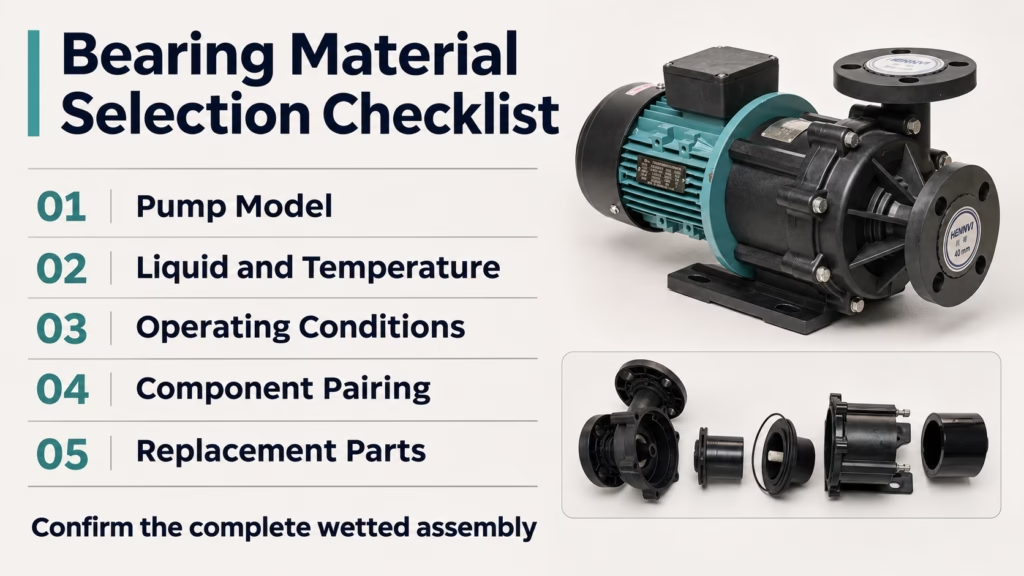
Bearing Material Selection Checklist
| Input | What to send |
|---|---|
| Pump identification | Model, serial number and parts drawing |
| Process liquid | Composition, concentration and temperature |
| Fluid condition | Solids, deposits or crystallisation |
| Operating pattern | Continuous duty, starts and stops, shutdown conditions |
| Liquid supply | Tank levels, air-ingress risk and suction arrangement |
| Previous damage | Photographs and maintenance records |
Frequently Asked Questions
Is silicon carbide always better than alumina?
There is no universal choice. Confirm the exact material grades, component pairing and operating conditions.
Does a PVDF casing mean every internal part is PVDF?
No. Request the complete wetted-material list.
Can a bearing material change solve repeated pump damage?
Only if the cause supports that change. Lubrication loss, deposits, incorrect assembly or unsuitable operating conditions also need investigation.
Discuss Your Pump Configuration with HENNVI
Send HENNVI your pump identification, process liquid data and operating conditions. For a replacement inquiry, include photographs of the existing components and available part numbers.
Request confirmation of the shaft, bearing and thrust-component configuration before ordering.
Need a Reliable Pump Solution for Corrosive Applications?
Hennvi Pump provides engineered chemical pump solutions including magnetic drive pumps, diaphragm pumps,centrifugal pumps, dosing pumps,vertical pumps and filtration systems for industrial applications. Share your working conditions and requirements with us. Our technical team will provide professional suggestions, datasheets and competitive pricing for your fluid‑handling solution.