
Chemical Pump Flange Compatibility: JIS, ANSI and DIN Checks Before Ordering
Get Product Catalog & Support
Fill out the form to get full specs and case studies.
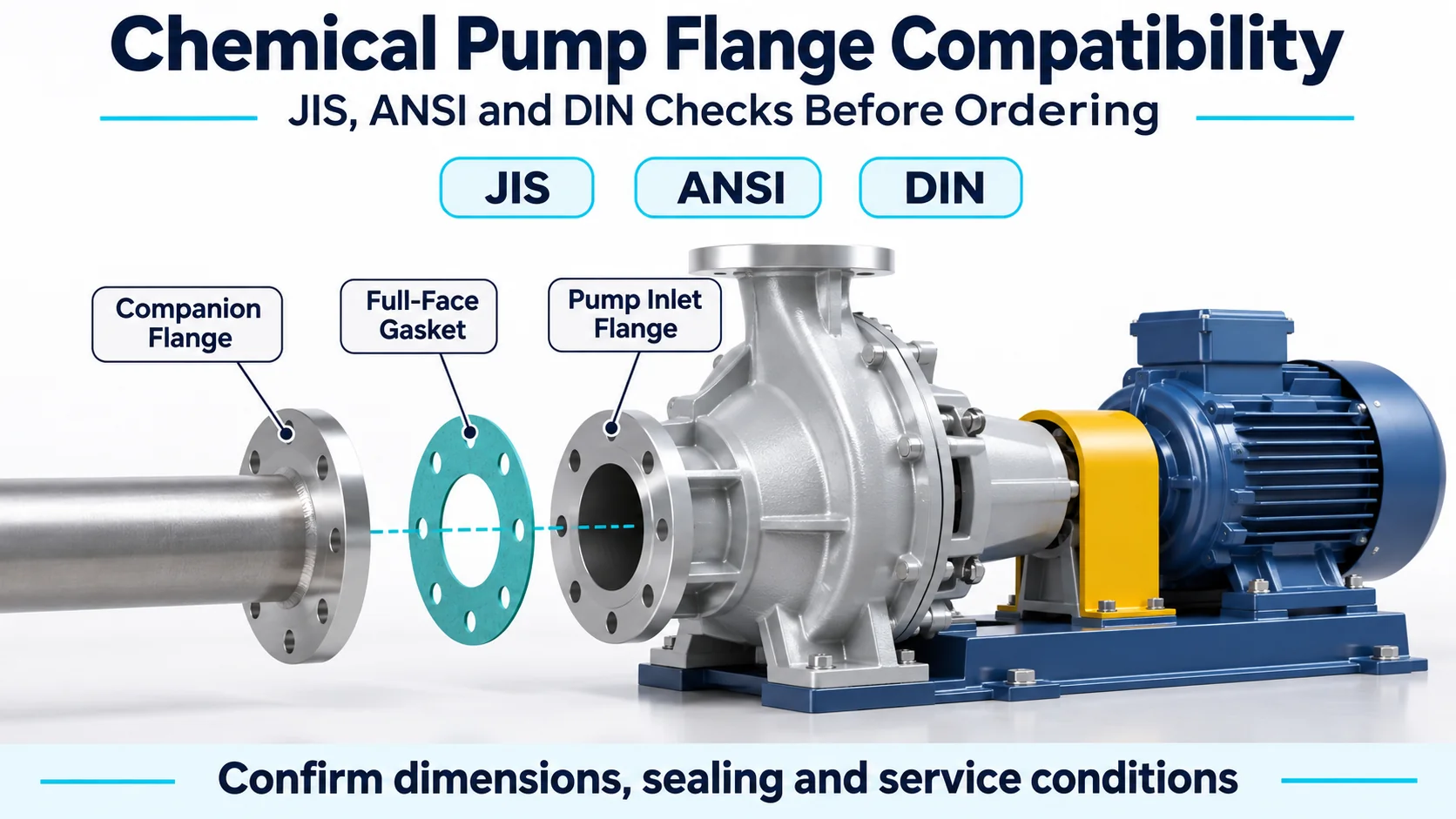
A replacement chemical pump can meet the required flow and head yet fail to fit the existing pipework. The connection may have a different bolt pattern, sealing face, or position—even when the nominal port size appears to match.
Chemical pump flange compatibility requires more than checking the inlet and outlet diameters. Before ordering, compare the proposed pump drawing with the existing connections and confirm the complete joint arrangement.
This guide explains what to check when a quotation specifies JIS, ANSI or DIN flanges, particularly when replacing a pump in an existing chemical transfer or circulation system.
Table of Contents
ToggleWhat Does Chemical Pump Flange Compatibility Mean?
A compatible connection must fit mechanically, provide an appropriate sealing arrangement, and remain suitable for the operating conditions.
Check three areas:
| Area | What needs confirmation |
|---|---|
| Dimensional fit | Size, bolt circle, hole arrangement, sealing dimensions, and connection position |
| Joint construction | Flange face, gasket or O-ring, backing components, and bolting |
| Service suitability | Materials, pressure, temperature, chemical compatibility, and installation loads |
Matching bolt holes is only one part of the review. It does not establish the pressure rating or chemical suitability of the assembled connection.
Understanding JIS, ANSI and DIN Pump Flanges
These descriptions identify different standard systems or commercial connection references. Ask for the exact designation rather than accepting “standard flange” on a quotation.
| Description on an inquiry | Information to request |
|---|---|
| JIS flange | Applicable standard, nominal size, pressure designation, face type, and drawing |
| ANSI flange | Exact standard intended, class, nominal size, face type, and drawing |
| DIN flange | Exact DIN or DIN EN standard, nominal size, PN designation, face type, and drawing |
JIS Flanges
JIS B 2220 covers steel pipe flanges and includes nominal pressure designations such as 5K, 10K and 16K.
For a plastic chemical pump described as having “JIS drilling,” clarify whether the supplier is referring to the connection dimensions or to a broader compliance claim. A steel flange standard does not, by itself, establish the pressure capability of a plastic pump connection. Japanese Standards Association: JIS B 2220
ANSI Flanges
“ANSI flange” is a common purchasing description, but the supplier should identify the actual standard.
ASME B16.5 is one widely used reference for pipe flanges and flanged fittings. Its scope includes dimensions, materials, pressure-temperature ratings, and recommendations concerning bolting and gaskets.
A quotation should identify more than “ANSI compatible.” Request the applicable size, class, facing, and connection drawing. ASME B16.5 scope
DIN and DIN EN Flanges
For a connection described as “DIN,” request the specific standard number. DIN EN 1092-1, for example, covers PN-designated circular steel flanges.
Do not infer the complete connection specification from “DIN” or “PN16” alone. Confirm the material, flange type, dimensions, and sealing arrangement. DIN Media: DIN EN 1092-1
1. Compare the Actual Flange Dimensions
Why Nominal Size Is Not Enough
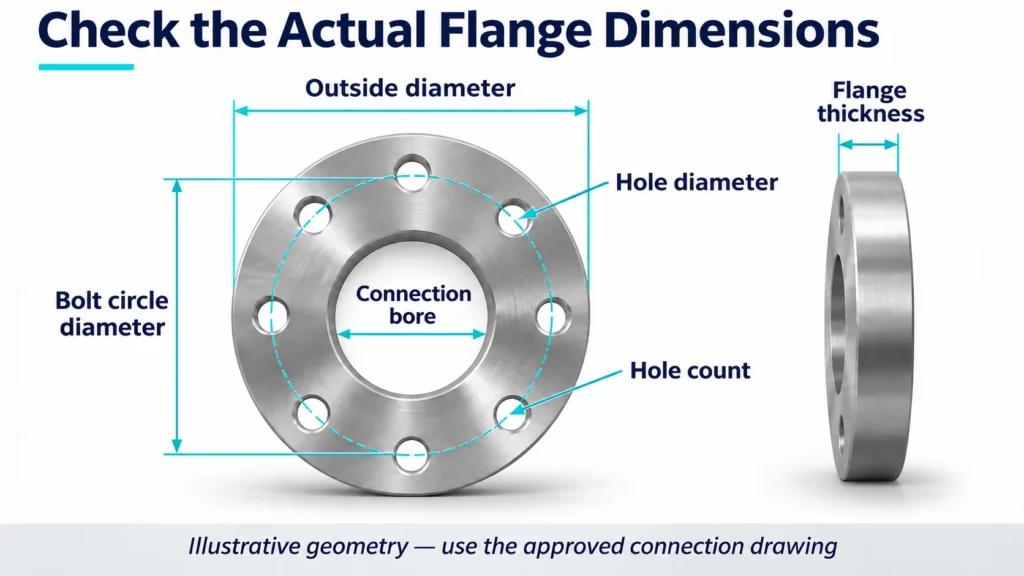
A label such as DN50 or 2-inch identifies a nominal size. It is not a complete flange drawing.
Before approving a replacement, compare the following dimensions separately for the suction and discharge connections.
| Dimension or feature | What to record |
|---|---|
| Nominal size | The marked connection size and standard |
| Outside diameter | Overall flange diameter |
| Bolt circle diameter | Diameter through the centres of the bolt holes |
| Bolt holes | Quantity, diameter, and angular orientation |
| Sealing face | Type, diameter, and relevant profile |
| Connection bore | Opening and relationship to the mating pipework |
| Assembly thickness | Flange, backing ring, gasket, and bolting arrangement |
Use dimensions from an approved drawing wherever possible. Photographs help identify an arrangement, but they should not replace dimensional confirmation.
What to Send the Supplier
Provide a front view of each connection, any visible markings, and a dimensional sketch. If measuring existing equipment, record the method and flag measurements that need confirmation.
Do not identify a flange standard from the outside diameter alone.
2. Check the Sealing Face and Gasket
Matching Holes Does Not Confirm the Seal
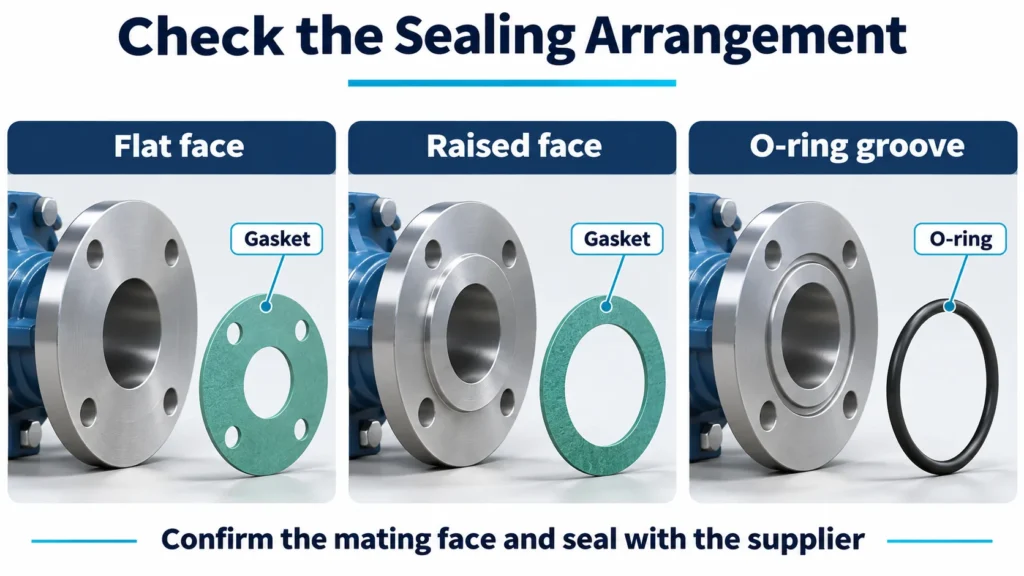
Flat-face, raised-face, and manufacturer-specific O-ring connections use different sealing arrangements.
Ask the supplier to identify:
- The mating face required.
- Gasket or O-ring dimensions.
- Seal material and thickness.
- Any required backing ring or supporting component.
- The approved bolting and tightening procedure.
For mixed face types or plastic-to-metal connections, request confirmation of the complete assembly rather than selecting a gasket by nominal diameter.
GF’s flange selection tool uses pipe material, dimensions, flange type, and gasket type to determine suitable components and tightening requirements. This illustrates why one universal gasket or torque value is insufficient. GF flange connection guidance
3. Confirm Pressure, Temperature and Chemical Suitability
A dimensional match does not establish an acceptable operating pressure.
Review the allowable conditions for the pump connection, mating flange, gasket, and other joint components. Include normal operation and relevant pressure or temperature extremes.
For chemical service, provide:
- Chemical composition and concentration.
- Normal and maximum operating temperature.
- Normal and maximum expected pressure.
- Cleaning liquids and cleaning temperature.
- Any operating changes that affect the connection.
Keep pressure designations in their original standard system. Do not treat JIS 10K, PN16 and ASME Class 150 as interchangeable pressure limits.
For a plastic pump, obtain the manufacturer’s rating for the actual connection and temperature. A metal backing ring or a familiar bolt pattern does not establish the rating of the complete assembly.
4. Check the Pump’s Connection Positions
Even compatible flanges may not provide a direct replacement if the pump geometry differs.
Compare:
| Installation feature | Replacement check |
|---|---|
| Suction centreline | Height and horizontal position |
| Discharge connection | Height, orientation, and position |
| Sealing face locations | Distance to the existing pipework |
| Baseplate | Footprint and fixing-hole positions |
| Maintenance space | Access for removal, inspection, and seal replacement |
| Pipe supports | Support arrangement around both connections |
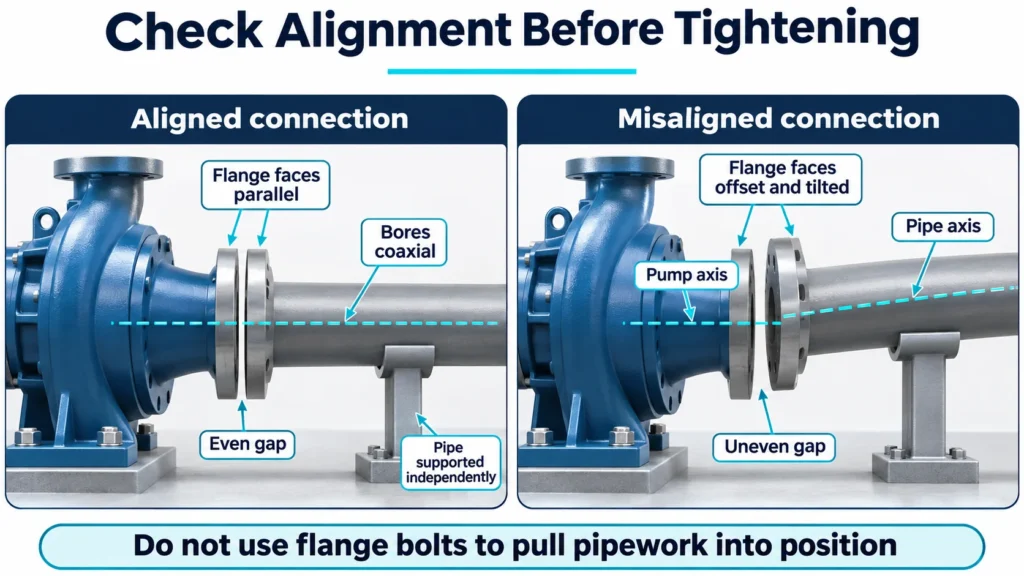
Flange bolts should not be used to pull misaligned pipework into place. The piping needs to align with the equipment without imposing unintended installation loads.
Asahi/America’s piping guidance calls for aligned, parallel sealing faces before tightening and addresses assembly requirements for plastic flange connections. Asahi/America Engineering Design Guide
5. Review Adapters and Universal Flanges Carefully
Can an Adapter Connect Different Standards?
An adapter may be a suitable part of an engineered replacement arrangement. Confirm both ends of the adapter and review the resulting assembly.
Ask about:
- Connection specifications on each side.
- Materials and operating limits.
- Sealing details.
- Additional installation length.
- Pipe support and clearance.
- Any effect on the flow path or system losses.
An adapter solves a particular interface problem; it does not automatically make the complete installation suitable.
What Does “Universal Flange” Mean?
Request a drawing showing the supported patterns and sealing arrangements.
Clarify whether “universal” refers to adjustable bolt positions, multiple drilling patterns, or another manufacturer-specific feature. Confirm the actual mating flange rather than relying on the term alone.
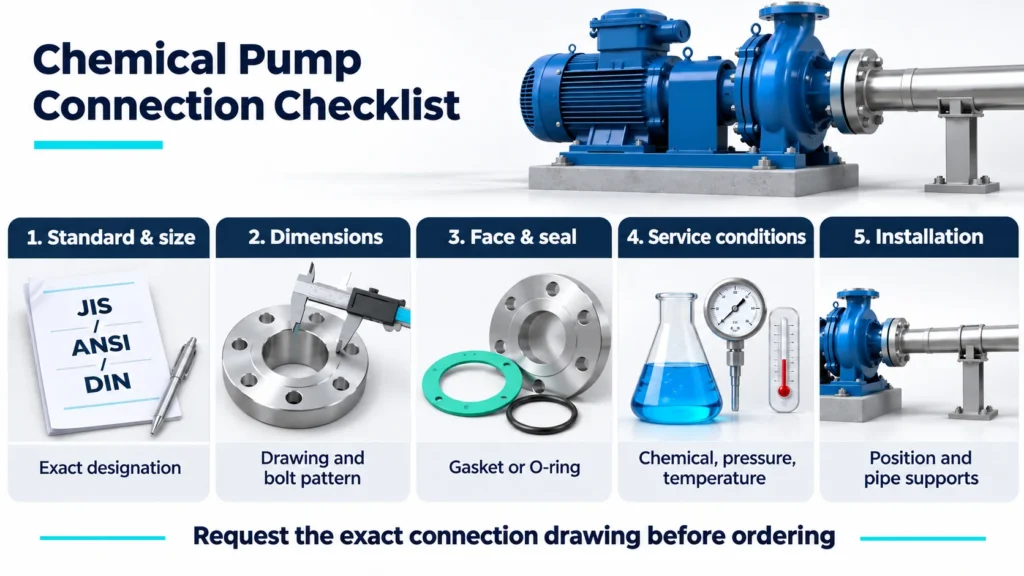
Chemical Pump Replacement Connection Checklist
Include the following information when requesting a quotation:
| Information | What to provide |
|---|---|
| Existing equipment | Pump model, nameplate photographs, and available drawings |
| Suction connection | Standard, size, dimensions, facing, and photographs |
| Discharge connection | Standard, size, dimensions, facing, and photographs |
| Seals | Existing gasket or O-ring details, if known |
| Operating conditions | Liquid, concentration, temperature, and pressure |
| Installation | Pipe positions, supports, baseplate, and available space |
| Required scope | Pump only, mating flanges, gaskets, bolts, or adapters |
Before ordering, request a connection drawing for the exact quoted configuration. Record any required pipework changes rather than leaving them to installation day.
Frequently Asked Questions
Are JIS, ANSI and DIN pump flanges interchangeable?
Do not assume interchangeability. Compare the exact dimensions, sealing arrangement, materials, and operating limits. Compatibility must be established for the specific connection.
Does the same nominal size mean the flanges will fit?
No. Nominal size alone does not define the bolt circle, hole arrangement, sealing face, or assembly dimensions.
Can I use the existing gasket with a replacement pump?
Only if it is confirmed as suitable for the new joint. Follow the equipment supplier’s requirements for gasket selection and replacement.
Can flange bolts correct pipe misalignment?
They should not be used to force the pipework into alignment. Check connection positions and pipe supports before tightening.
Is matching the flange enough to approve a replacement pump?
No. The replacement also needs to meet the hydraulic duty, chemical compatibility, electrical requirements, and installation conditions.
Discuss Your Chemical Pump Connections with HENNVI
When replacing a chemical pump, send HENNVI photographs and dimensions of both existing connections, together with the required flow, head, liquid specification, and site power supply.
Include the existing pump drawing if available and identify whether pipework changes are possible.
Contact HENNVI to request a configuration-specific quotation and connection drawing for review before ordering.
Need a Reliable Pump Solution for Corrosive Applications?
Hennvi Pump provides engineered chemical pump solutions including magnetic drive pumps, diaphragm pumps,centrifugal pumps, dosing pumps,vertical pumps and filtration systems for industrial applications. Share your working conditions and requirements with us. Our technical team will provide professional suggestions, datasheets and competitive pricing for your fluid‑handling solution.