
50Hz vs 60Hz Chemical Pumps: How to Check Motors and Pump Curves

Get Product Catalog & Support
Fill out the form to get full specs and case studies.
Choosing between a 50Hz and a 60Hz chemical pump starts with the site power supply and the required flow and head. A 60Hz configuration can have a different pump curve, even when the model designation and motor power appear the same. Before ordering or replacing a centrifugal chemical pump, match the motor rating to the site supply and check the curve for the exact pump configuration.
Table of Contents
Toggle50Hz vs 60Hz Chemical Pumps: How Performance Changes
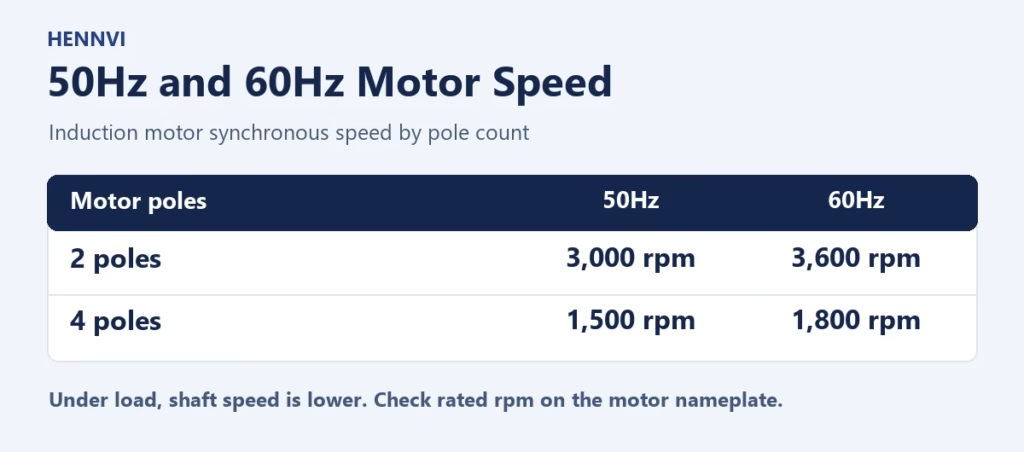
For a directly connected induction motor with the same number of poles, 60Hz gives a synchronous speed 20% higher than 50Hz. A two-pole motor has a synchronous speed of 3,000 rpm at 50Hz and 3,600 rpm at 60Hz. For a four-pole motor, the corresponding speeds are 1,500 and 1,800 rpm. Under load, the shaft runs below synchronous speed. Use the rated rpm on the motor nameplate or datasheet and check the speed stated on the pump curve.
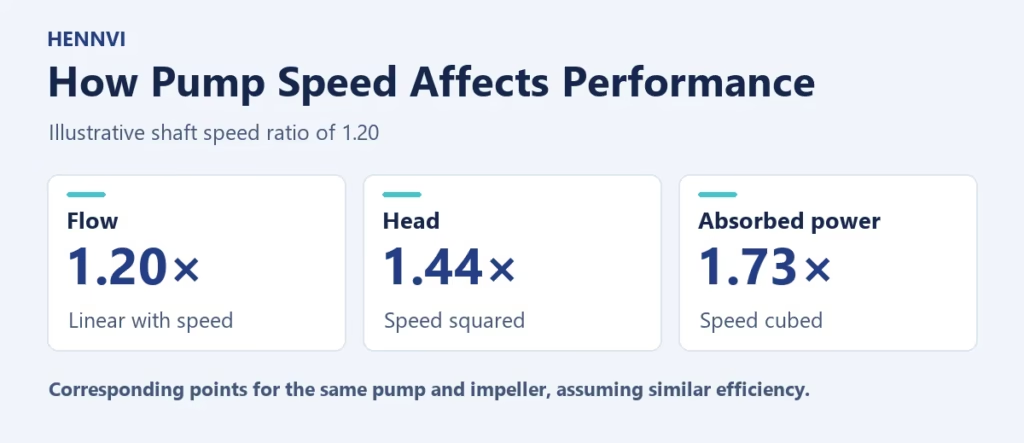
For the same centrifugal pump and impeller, a speed increase can raise flow, head and absorbed power. The affinity laws give a preliminary estimate at corresponding points. With a shaft speed ratio of 1.20 and approximately constant efficiency, the estimated ratios are 1.20 for flow, 1.44 for head and 1.73 for absorbed power. The installed operating point is where the applicable pump curve meets the system curve. Hydraulic Institute pump curve guidance
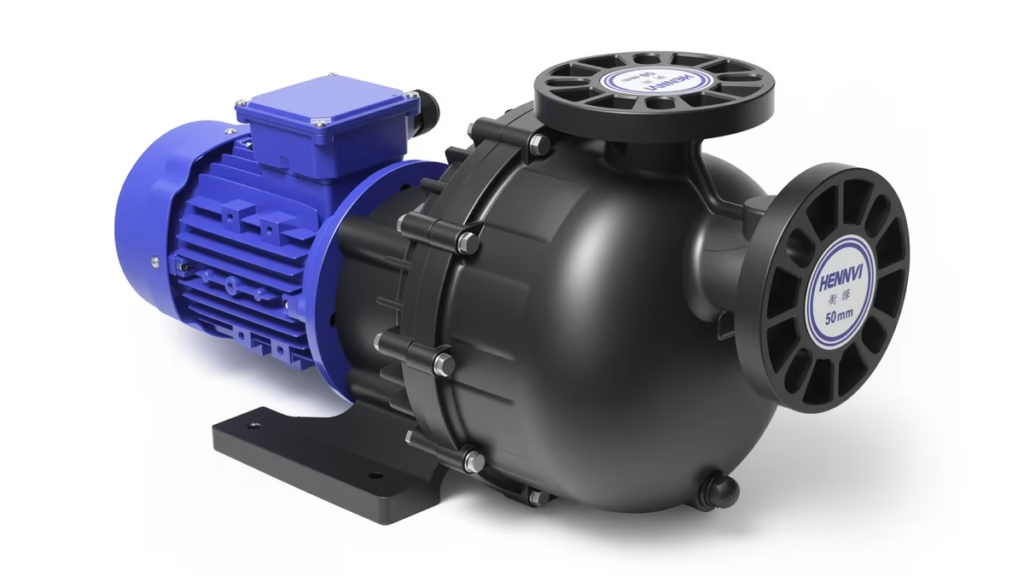
HENNVI HKB Example: Same Maximum Flow, Different Maximum Head
The HENNVI HKB Series lists separate specifications for 50Hz and 60Hz. In the full HKB ordering code, the last digit identifies the frequency. Code 5 means 50Hz and code 6 means 60Hz. Ask for the full ordering code on the quotation.
| HKB-40012L catalogue specification | 50Hz | 60Hz |
|---|---|---|
| Maximum flow | 240 L/min | 240 L/min |
| Maximum head | 13 m | 16 m |
The catalogue lists water with a specific gravity of 1.0 as the test liquid. Maximum flow and maximum head describe separate points on the curve.
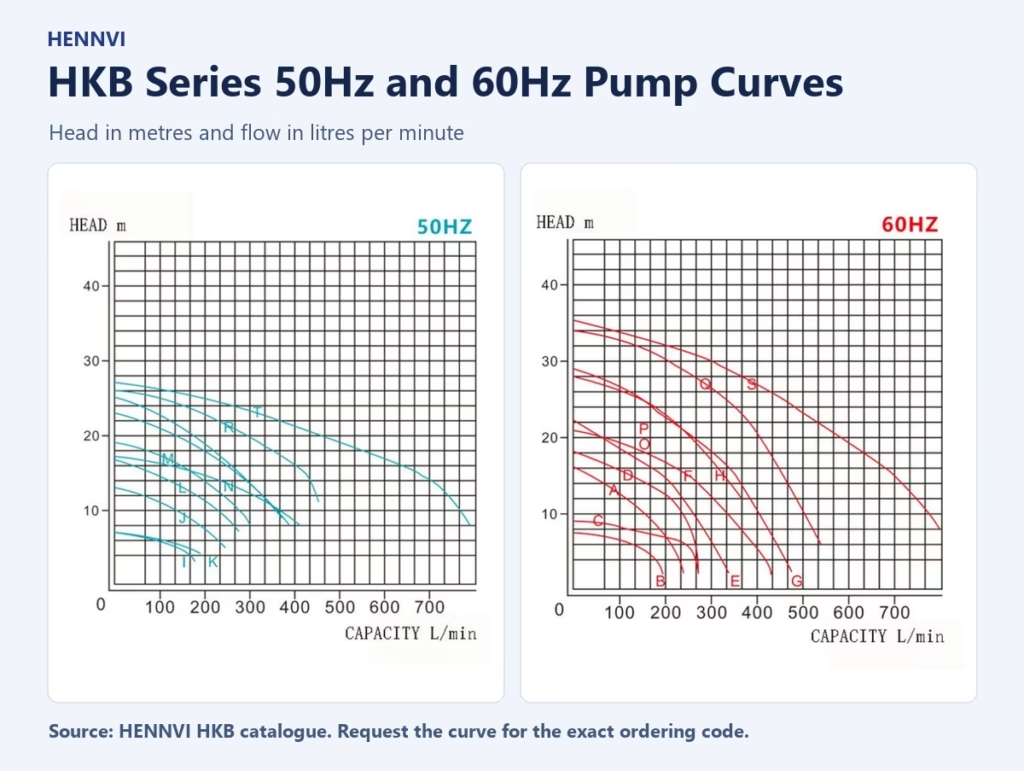
Suppose a chemical circulation system needs 100 L/min at 14 m of total head. The 50Hz HKB-40012L can be ruled out because its listed maximum head is 13 m. The 60Hz version stays on the shortlist, but its 16 m maximum head only shows that the required head is within the published limit.
Ask HENNVI for the exact 60Hz curve and check the available head at 100 L/min. Then verify the operating range and power demand for the actual process liquid. If the site supply is 50Hz, ask for a 50Hz configuration that meets the duty.
Check the Motor Nameplate and Match It to the Pump Curve
| Check | What to verify before ordering |
|---|---|
| Site supply and motor rating | Match the site voltage, phase and frequency to the motor rating. For a dual-rated motor, use the voltage, connection, current, output and rpm specified for the intended supply. |
| Pump model and curve | Confirm the full ordering code, impeller configuration and speed. Ask for the corresponding flow–head curve with the required duty point marked. |
| Power and suction | Check absorbed power across the expected flow range against the motor rating. Ask for the allowable flow range, required NPSH where applicable, and any priming or suction limits. |
| Process liquid and installation | Provide the liquid composition, concentration, temperature, specific gravity, viscosity and solids content. Confirm wetted materials, pipe connections and suction conditions at the lowest tank level. |
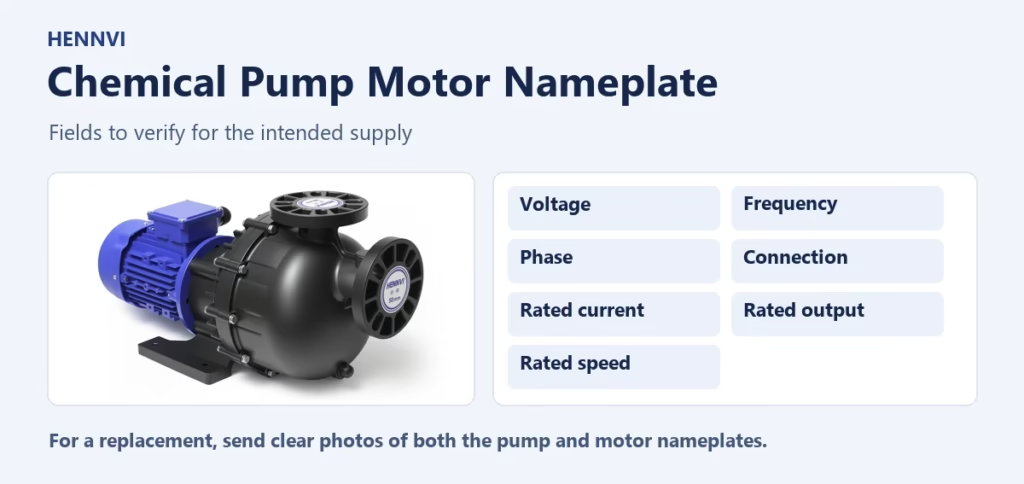
The ABB motor nameplate guide explains how rated speed, current and output relate to the specified voltage and frequency.
For a replacement, send clear photos of both the pump and motor nameplates. Include the measured flow and pressure if available, along with the operating problem you want to solve.
If the pump feeds a filter, specify the required flow and the head with both a clean and a loaded filter. See how to calculate head for a chemical circulation pump. For tank-mounted HSP models, see the 50Hz vs 60Hz vertical chemical pump guide.
Can a 50Hz Chemical Pump Run on 60Hz?
Only if the motor is rated for the intended supply and the pump manufacturer confirms that the complete assembly can operate at the resulting speed. Check absorbed power, maximum pump speed, pressure limits and the expected flow range.
A motor marked 50/60Hz may have separate electrical ratings for each frequency. Use the rating for the site supply and request the corresponding pump curve.
Can a 60Hz Chemical Pump Run on 50Hz?
Confirm the motor rating and request the pump curve for 50Hz. A lower shaft speed can reduce the available head enough to miss the required duty, particularly when the system has significant static head or a loaded filter.
Can a VFD Help Match the Required Pump Speed?
A variable frequency drive (VFD) can set the output frequency for a compatible motor. Provide the site supply and intended speed range. Ask the supplier to confirm the drive input and output ratings, motor cooling and load limits, and the pump’s allowable speed and flow range.
Request a Pump Curve and Quotation
For a new installation, send HENNVI your site voltage, phase and frequency, required flow and head, liquid properties, and a piping sketch showing tank levels and filters. For a replacement, add the existing model and clear photos of both nameplates.
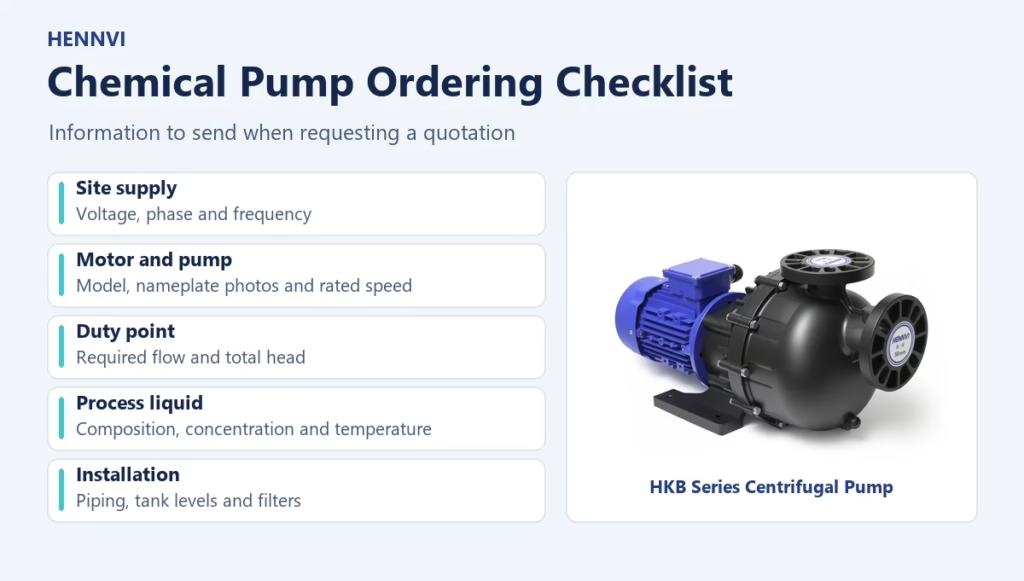
Request a chemical pump selection and quotation from HENNVI. Ask for the full ordering code, motor datasheet and performance curve with your duty point marked.
Need a Reliable Pump Solution for Corrosive Applications?
Hennvi Pump provides engineered chemical pump solutions including magnetic drive pumps, diaphragm pumps,centrifugal pumps, dosing pumps,vertical pumps and filtration systems for industrial applications. Share your working conditions and requirements with us. Our technical team will provide professional suggestions, datasheets and competitive pricing for your fluid‑handling solution.