
Magnetic Drive Pump vs Mechanical Seal Pump: Which One Is Better for Chemical Transfer?
Get Product Catalog & Support
Fill out the form to get full specs and case studies.
In chemical processing industries, selecting the right pump is essential for safe and efficient liquid transfer. Many applications involve corrosive, hazardous, or high-value chemicals, where pump leakage and frequent maintenance can lead to production losses and safety risks.
Two common pump designs used for chemical transfer are magnetic drive pumps and mechanical seal pumps. Although both can transport chemical liquids, they have significant differences in sealing structure, reliability, maintenance requirements, and application suitability.
Understanding the difference between these two pump types can help you choose the right solution for acid, alkali, and corrosive liquid transfer applications.
Table of Contents
ToggleWhat Is a Magnetic Drive Pump?
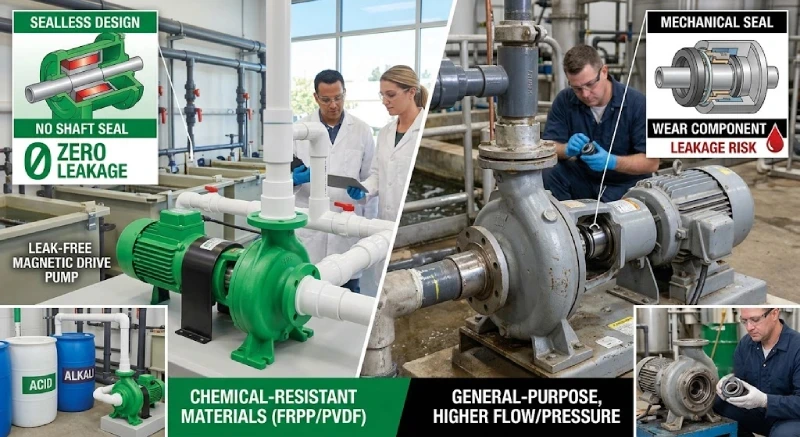
A magnetic drive pump is a type of sealless chemical pump that uses magnetic coupling to transfer power from the motor to the impeller. Unlike traditional pumps, it does not require a shaft seal between the motor and pump chamber.
The inner magnet and outer magnet rotate together, driving the impeller while keeping the pumped liquid completely isolated inside the pump chamber.
Key advantages of magnetic drive pumps:
- Leak-free operation
- No mechanical shaft seal
- Reduced maintenance requirements
- Excellent corrosion resistance
- Suitable for hazardous chemical liquids
Because there is no shaft seal that can wear or fail, magnetic drive pumps are widely used for chemical transfer applications where leakage prevention is critical.
Common applications include:
- Electroplating systems
- PCB manufacturing
- Semiconductor processing
- Chemical production
- Wastewater treatment
What Is a Mechanical Seal Pump?
A mechanical seal pump uses a rotating shaft and mechanical seal structure to prevent liquid leakage between the pump body and motor.
Mechanical seal pumps are widely used in many industrial applications because of their simple design and ability to handle various flow requirements.
However, the mechanical seal is a wearing component. During long-term operation, factors such as chemical corrosion, dry running, particles, or high temperature may cause seal damage.
Advantages of mechanical seal pumps:
- Suitable for general industrial applications
- Available for higher flow and pressure requirements
- Mature and widely used technology
Potential limitations:
- Mechanical seal wear
- Possible leakage risk
- Higher maintenance requirements
- Seal compatibility must be considered when handling corrosive chemicals
For applications involving aggressive chemicals, the pump material and sealing system must be carefully selected.
Magnetic Drive Pump VS Mechanical Seal Pump: Key Differences
| Feature | Magnetic Drive Pump | Mechanical Seal Pump |
|---|---|---|
| Sealing structure | Sealless magnetic coupling | Mechanical shaft seal |
| Leakage risk | Almost zero leakage | Possible leakage from seal wear |
| Maintenance | Low maintenance | Requires seal inspection and replacement |
| Chemical resistance | Excellent with suitable materials | Depends on seal and material selection |
| Safety | Higher safety for hazardous liquids | Requires regular maintenance |
| Best application | Corrosive and chemical liquids | General industrial liquids |

Why Choose a Magnetic Drive Pump for Chemical Transfer?
For chemical liquid applications, preventing leakage is one of the most important factors.
A leaking pump may cause:
- Chemical contamination
- Equipment corrosion
- Safety hazards
- Production downtime
A magnetic drive chemical pump eliminates the traditional shaft sealing problem by using a completely sealed pump chamber.
Leak-Free Chemical Transfer
The absence of a mechanical shaft seal greatly reduces the possibility of chemical leakage.
This makes magnetic drive pumps ideal for:
- Strong acids
- Alkali solutions
- Corrosive chemicals
- Dangerous liquids
Better Corrosion Resistance
Magnetic drive pumps are commonly manufactured using corrosion-resistant materials such as:
- FRPP (Polypropylene)
- PVDF
These materials provide excellent resistance against many chemical liquids and are suitable for demanding industrial environments.
Lower Maintenance Cost
Compared with mechanical seal pumps, magnetic drive pumps have fewer wearing parts.
Benefits include:
- Longer service life
- Less downtime
- Reduced maintenance frequency
This is especially valuable for factories operating continuous production lines.
How to Choose the Right Magnetic Drive Pump?
Choosing the correct magnetic drive pump requires considering several important factors.
Chemical Compatibility
Different chemicals require different materials.
Before selecting a pump, confirm:
- Chemical type
- Concentration
- Temperature
- PH value
For example:
- FRPP pumps are suitable for many general acid and alkali applications.
- PVDF pumps provide higher chemical resistance and temperature capability.
Flow Rate and Head Requirements
Pump selection should match your system requirements.
Important parameters include:
- Flow rate (L/min or m³/h)
- Pump head (meter)
- Pipe size
- Motor power
- Voltage requirements
Choosing the correct specifications ensures stable and efficient operation.
Application Environment
Different industries may require different pump structures.
Examples:
Electroplating Industry
Requires reliable chemical circulation and corrosion resistance.
PCB Manufacturing
Requires stable transfer of etching and cleaning chemicals.
Semiconductor Industry
Requires high reliability and contamination control.
Need a Reliable Pump Solution for Corrosive Applications?
Hennvi Pump provides engineered chemical pump solutions including magnetic drive pumps, diaphragm pumps,centrifugal pumps, dosing pumps,vertical pumps and filtration systems for industrial applications. Share your working conditions and requirements with us. Our technical team will provide professional suggestions, datasheets and competitive pricing for your fluid‑handling solution.
Hennvi Magnetic Drive Pump Solutions
Hennvi provides professional magnetic drive chemical pumps designed for reliable acid, alkali, and corrosive liquid transfer.
Our magnetic drive pump solutions feature:
- Sealless magnetic drive structure
- FRPP and PVDF material options
- Excellent corrosion resistance
- Low maintenance operation
- OEM customization capability
Hennvi magnetic pumps are widely used in industries including electroplating, PCB manufacturing, chemical processing, and environmental protection.
With professional manufacturing experience and technical support, Hennvi helps customers select suitable pump solutions according to their application requirements.
Conclusion
Both magnetic drive pumps and mechanical seal pumps have their own advantages. However, for applications involving corrosive, hazardous, or valuable chemical liquids, a magnetic drive pump is often the safer and more reliable choice.
With leak-free operation, corrosion-resistant materials, and lower maintenance requirements, magnetic drive chemical pumps provide an efficient solution for modern chemical transfer systems.
If you need help selecting the right chemical pump for your application, Hennvi can provide professional recommendations based on your liquid type, flow rate, and operating conditions.