
Diaphragm Pump Muffler Freezing and How to Stop It

Get Product Catalog & Support
Fill out the form to get full specs and case studies.
An air-operated double diaphragm (AODD) pump starts a transfer normally. Several minutes later, frost spreads across the exhaust muffler, the pump begins to miss strokes, and flow drops. That pattern makes diaphragm pump muffler freezing worth checking. Start with the compressed air supply and exhaust path before ordering a replacement air valve or diaphragm. Graco AODD troubleshooting guide
Table of Contents
ToggleWhy Does an AODD Pump Muffler Freeze?
Compressed air cools as it expands on its way out of the pump. If the air carries enough moisture, ice can form in the muffler or exhaust passages. This can happen indoors, even when the room is above freezing. Ice inside the exhaust path can restrict airflow and make the pump cycle unevenly or stall. Wilden air distribution system troubleshooting guide
A useful observation is when the flow drops. If the pump runs well at startup and loses flow as ice builds, investigate the exhaust and air moisture. If the pump struggles as soon as it starts, check the air pressure at the pump while it is cycling. A regulator can show adequate pressure at rest even when an undersized hose or fitting restricts the air supply under load. Graco AODD troubleshooting guide
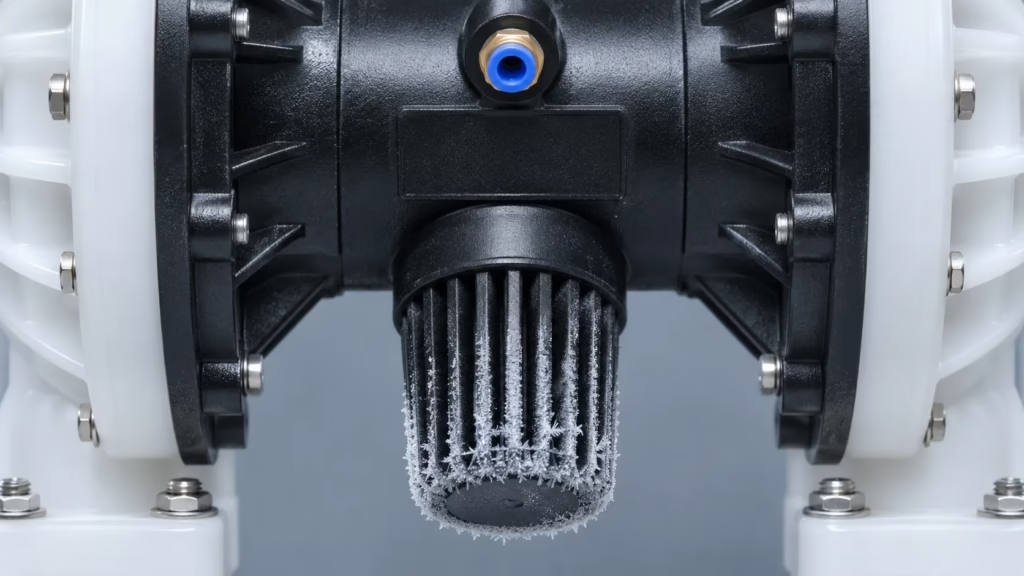
How to Troubleshoot AODD Pump Exhaust Icing
| What you observe | What to check first |
|---|---|
| Frost on the muffler while cycling and flow remain steady | Record when frost appears and watch for a change in flow or stroke pattern. Surface frost alone does not establish an exhaust blockage. |
| Pump slows or stalls as ice accumulates | Check for exhaust restriction and review the air supply for moisture. |
| Inlet air pressure drops as soon as the pump cycles | Check the hose, quick couplers, filter and regulator for restrictions. |
| Liquid from the process appears at the air exhaust | Shut down and follow site isolation procedures. Have maintenance check for a diaphragm or liquid-side seal failure. |
Before removing the muffler or opening the pump, isolate the air supply and relieve trapped air and liquid pressure using the procedure for the installed model. If liquid at the exhaust could be the chemical being transferred, follow the site’s chemical spill procedure. A damaged diaphragm can let process fluid reach the air exhaust. Graco AODD troubleshooting chart · Graco air exhaust and pressure relief manual
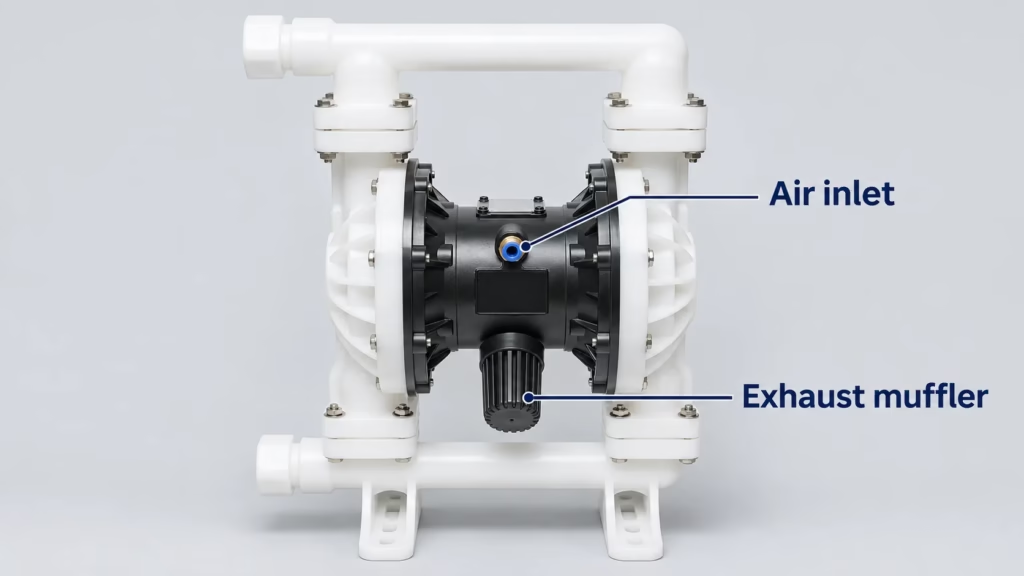
1. Check the Air Supply for Moisture
Inspect the point-of-use filter bowl and drain, then check the dryer and upstream drains. A separator can collect liquid condensate. A dryer addresses water vapor by lowering the pressure dew point. If icing returns after the bowl is drained, ask the compressed-air supplier to check the air quality at the pump branch while the system is running. Atlas Copco guide to pressure dew point

2. Check the Exhaust Path
Once the pump is safely isolated, have maintenance inspect the muffler and any exhaust hose for ice, deposits, kinks or other restrictions. If the muffler needs replacement, match it to the installed model. For a remote exhaust on a chemical transfer pump, confirm the permitted hose size, routing and discharge location before changing the installation. Graco air exhaust installation manual
4. Gear Pumps and Progressive Cavity Pumps
Gear pumps transport liquid through spaces formed by rotating gears and the surrounding housing. They are among the rotary positive displacement technologies considered for viscous-liquid handling.
Progressive cavity pumps use a rotor and stator to form cavities that move liquid through the pump. They are another technology to evaluate for viscous or solids-containing media.
For either design, provide the actual fluid properties rather than choosing from a general application label. Discuss abrasion, solids, material compatibility, and maintenance with the supplier. NETZSCH’s overview of rotary displacement technologies
3. Check Whether the Pump Is Cycling Faster Than the Duty Requires
If the transfer can run at a lower rate, adjust the air supply within the model’s operating range and verify that the pump still delivers the required flow against the actual discharge pressure. If the process requires the current flow, check the available air capacity, air treatment and pump size at that duty point. Graco guide to AODD pump operation
What to Check on a HENNVI VA Series Diaphragm Pump
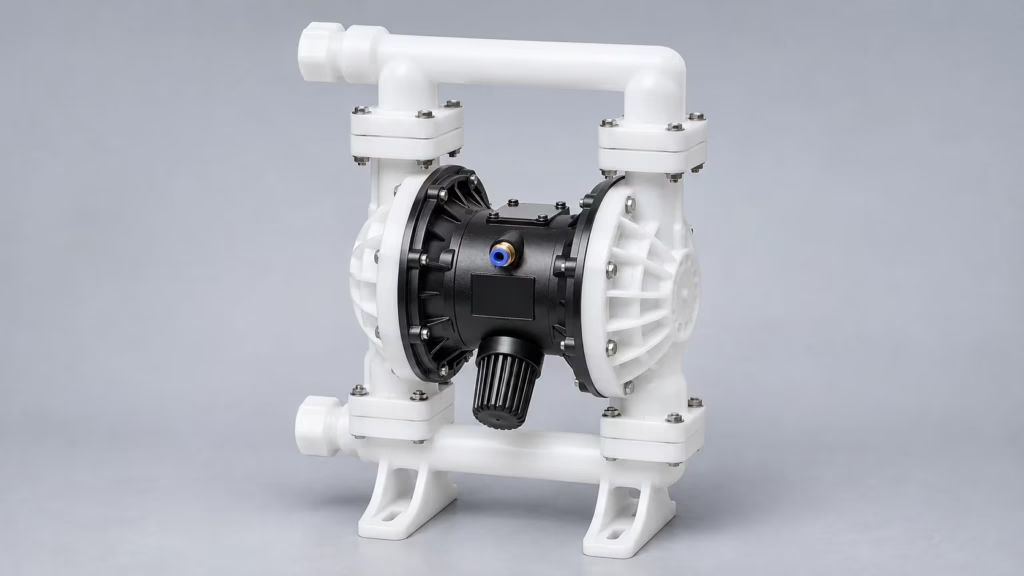
HENNVI’s VA Series uses compressed air to drive two diaphragms. One catalogue example, VA-25-PP-PP-TF-TF, has nominal 1-inch liquid ports, a polypropylene body and valve seats, and PTFE check balls and diaphragms. When requesting a replacement part or troubleshooting help, provide the full model code. The 1-inch designation describes the liquid connection. Ask HENNVI to confirm the air inlet and exhaust connection sizes separately. HENNVI VA Series diaphragm pumps
For a chemical transfer application, review wetted materials against the actual liquid, its concentration and operating temperature. For recurring exhaust icing, review the air pressure at the pump while it runs, the air treatment and how long the pump operates before flow drops. Those details help distinguish a pump configuration question from a problem in the air supply or exhaust. HENNVI VA Series diaphragm pumps · Graco AODD troubleshooting guide
Frequently Asked Questions
Can a diaphragm pump muffler freeze in a warm room?
Yes. Air cools as it expands through the pump exhaust. Moisture can freeze at the muffler even when the surrounding air is above freezing. Wilden troubleshooting guide
Will a new muffler stop the icing?
A replacement can restore airflow if the old muffler is clogged or damaged. If the compressed air still carries enough moisture to freeze under the same operating conditions, the icing can return. Graco AODD troubleshooting chart
Why does my pump still cycle when liquid flow drops?
If the pump continues cycling after the exhaust has been checked, look for a restricted suction line, an air leak at a suction connection or a sticking check valve. These can reduce liquid delivery while the pump continues to stroke. Wilden troubleshooting guide
Discuss Your Chemical Transfer Application with HENNVI
For recurring icing on a VA Series pump, send the full model code, chemical name and concentration, liquid temperature, required flow, discharge pressure, and air pressure measured at the pump while it cycles. Include a photo of the air filter, regulator and exhaust layout, along with the time it takes for frost or flow loss to appear. Contact HENNVI about your VA Series pump
Need a Reliable Pump Solution for Corrosive Applications?
Hennvi Pump provides engineered chemical pump solutions including magnetic drive pumps, diaphragm pumps,centrifugal pumps, dosing pumps,vertical pumps and filtration systems for industrial applications. Share your working conditions and requirements with us. Our technical team will provide professional suggestions, datasheets and competitive pricing for your fluid‑handling solution.