
Chemical Pump Types: Working Principles, Differences, and Applications
Get Product Catalog & Support
Fill out the form to get full specs and case studies.
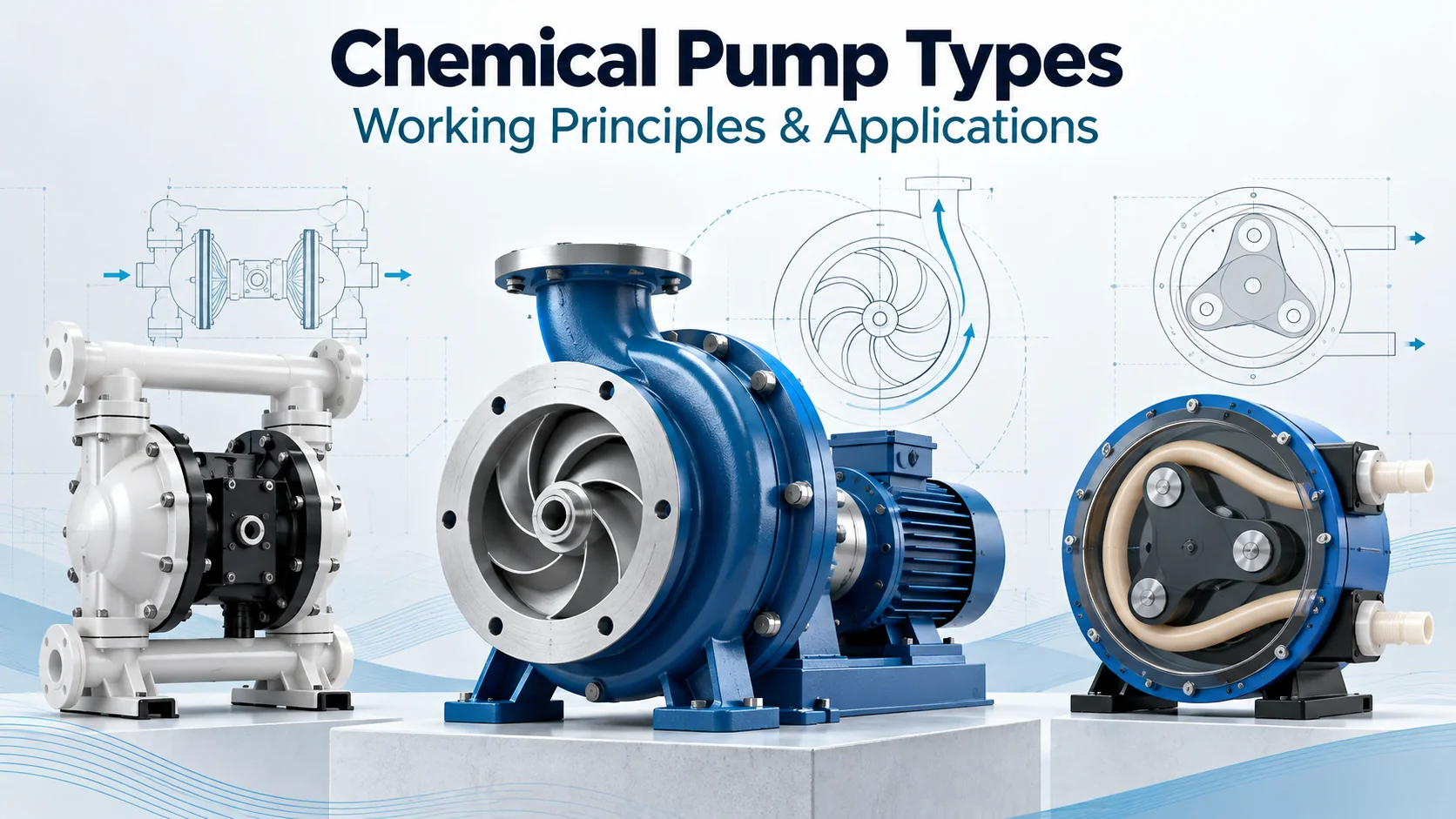
Chemical pump types are best understood by separating the pumping principle from the equipment configuration. Centrifugal pumps and positive displacement pumps describe how liquid moves. Magnetic drive describes how power reaches the pumping element, while terms such as vertical pump and drum pump describe an arrangement or application.
Understanding these differences helps engineers and purchasing teams compare equipment on a consistent basis.
This guide explains common chemical pump technologies, their working principles, and the questions to ask when selecting a pump for transfer, circulation, or dosing.
Table of Contents
ToggleChemical Pump Technologies at a Glance
The following table provides a starting point for technical discussion. Final suitability depends on the selected model and operating conditions.
| Technology | Working principle | Applications to evaluate | Important selection checks |
|---|---|---|---|
| Centrifugal | A rotating impeller transfers energy to liquid | Transfer and process circulation | Duty point, suction conditions, viscosity, materials |
| Diaphragm | A moving diaphragm changes chamber volume | Chemical transfer or metering, depending on design | Diaphragm and valve compatibility, solids, flow control |
| Peristaltic | Rollers or shoes compress a flexible tube or hose | Dosing and compatible transfer duties | Tubing compatibility, pressure, tube life |
| Gear | Rotating gears carry liquid through the pumping chamber | Compatible viscous-liquid transfer | Clearances, lubricating properties, abrasion |
| Progressive cavity | A rotor and stator form moving cavities | Viscous or solids-containing fluids | Stator compatibility, solids, operating limits |
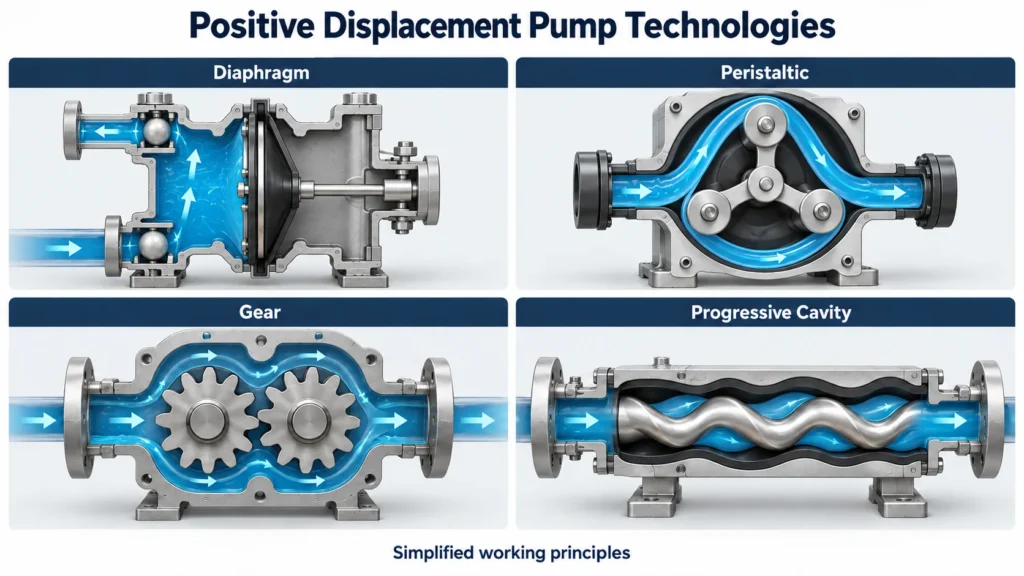
Diaphragm, peristaltic, gear, and progressive cavity pumps are positive displacement technologies. Their operating characteristics differ, so they should not be treated as interchangeable. Graco’s industrial pump comparison
1. Centrifugal Chemical Pumps
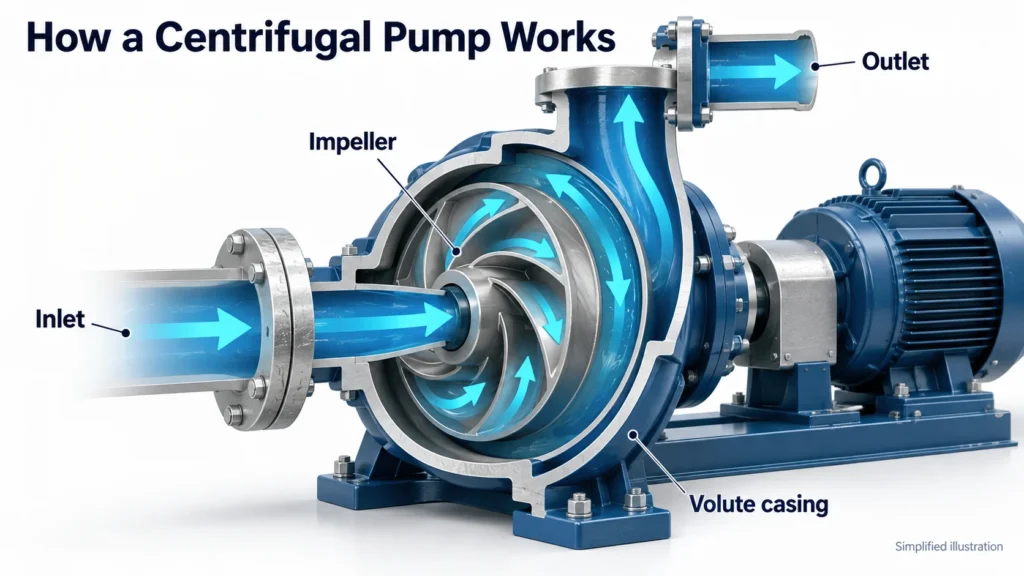
Working Principle
A rotating impeller adds energy to the liquid. The pump casing guides the flow toward the discharge, allowing the pump to meet a particular combination of flow and head.
Centrifugal pumps are commonly evaluated for relatively low-viscosity liquids and continuous transfer or circulation duties.
What to Check
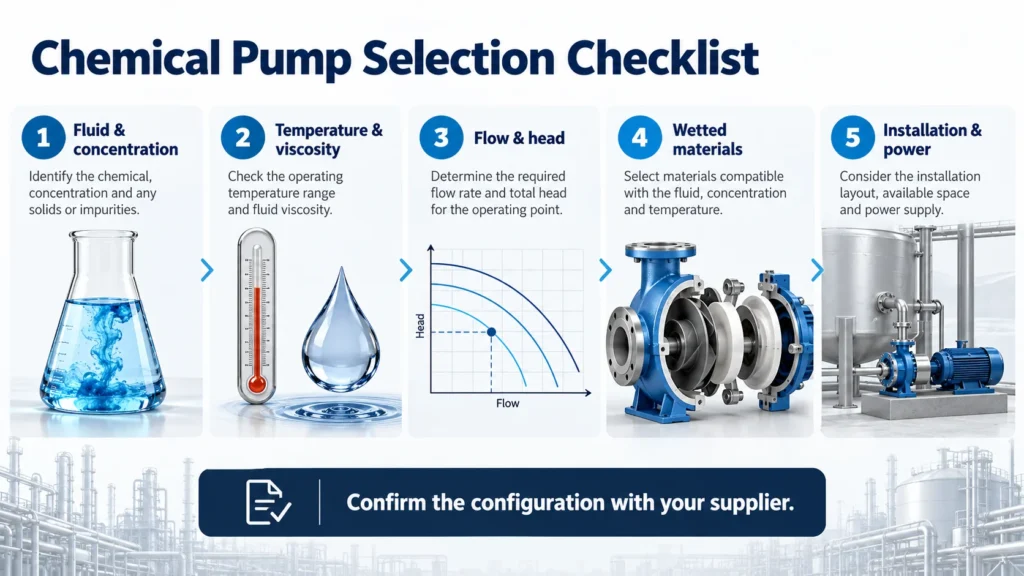
Select the pump using the required operating point and the applicable performance curve. Do not assume that maximum flow and maximum head occur together.
Ask the supplier to review:
- Required flow and total head.
- Fluid viscosity and specific gravity.
- Suction conditions.
- Wetted materials.
- Permitted operating range.
These checks matter when comparing pumps for a chemical circulation loop or a chemical transfer line. Graco’s discussion of centrifugal pump applications
2. Diaphragm Chemical Pumps
Working Principle
A flexible diaphragm moves to change the volume of a pumping chamber. Inlet and outlet valves direct the liquid through the pump.
Diaphragm pumps include different drive and control arrangements. An air-operated double-diaphragm transfer pump and a diaphragm metering pump should therefore be evaluated against different performance requirements.
What to Check
For transfer, define the liquid properties, solids, required flow, and available utilities.
For dosing, specify the required delivery range, discharge pressure, and control requirements. Ask the supplier to document achievable performance under your process conditions.
Diaphragm material and valve construction also need compatibility review. KSB identifies diaphragm designs within the positive displacement family and describes chemical dosing as one application of displacement pumps. KSB’s positive displacement pump reference
3. Peristaltic Chemical Pumps
Working Principle
A peristaltic pump moves liquid by compressing a flexible tube or hose. The liquid travels inside that tube or hose during normal operation.
What to Check
Tubing selection is central to performance. Confirm:
- Chemical compatibility.
- Working temperature and pressure.
- Required flow.
- Tube dimensions and approved pumphead combination.
- Inspection and replacement requirements.
Tubing influences suction capability, flow, efficiency, and service life. A chemically compatible material must also meet the mechanical demands of repeated compression. Watson-Marlow’s tubing selection guidance
4. Gear Pumps and Progressive Cavity Pumps
Gear pumps transport liquid through spaces formed by rotating gears and the surrounding housing. They are among the rotary positive displacement technologies considered for viscous-liquid handling.
Progressive cavity pumps use a rotor and stator to form cavities that move liquid through the pump. They are another technology to evaluate for viscous or solids-containing media.
For either design, provide the actual fluid properties rather than choosing from a general application label. Discuss abrasion, solids, material compatibility, and maintenance with the supplier. NETZSCH’s overview of rotary displacement technologies
Where Do Magnetic Drive Chemical Pumps Fit?
Magnetic drive is a power transmission arrangement. In a magnetic drive centrifugal pump, a magnetic coupling transmits rotation to the impeller across a containment boundary, removing the conventional rotating shaft seal through that boundary.
This distinction is useful when comparing sealed and sealless centrifugal designs.
However, magnetic drive does not establish universal chemical compatibility or unrestricted operating capability. Confirm the specific model’s wetted materials, fluid requirements, and operating instructions. Chemical centrifugal pumps are available with both mechanical seals and magnetic couplings. Finish Thompson’s chemical pump technology guide
Are Vertical Pumps and Drum Pumps Separate Technologies?
These terms describe the equipment arrangement or task rather than one universal working principle.
A vertical configuration changes how the equipment is installed. A drum pump is arranged to withdraw liquid from a drum or similar container.
When comparing these pumps, ask which pumping mechanism is used and how the complete assembly suits the installation. For drum transfer, include container dimensions, liquid properties, and discharge requirements. Finish Thompson’s discussion of drum and chemical transfer pumps

Centrifugal vs. Positive Displacement Pumps
| Comparison | Centrifugal pump | Positive displacement pump |
|---|---|---|
| Energy transfer | Rotating impeller adds energy to liquid | Pumping elements enclose and displace liquid |
| Performance review | Evaluate the pump curve against system requirements | Evaluate displacement, speed, pressure, and design-specific losses |
| Technology examples | Centrifugal process and circulation pumps | Diaphragm, peristaltic, gear, progressive cavity |
| Selection focus | Hydraulic duty, fluid properties, suction conditions | Mechanism suitability, fluid properties, pressure, control |
Neither family is automatically the better industrial chemical pump. The appropriate choice follows from the process specification. KSB’s explanation of displacement pumping
How to Select a Chemical Pump for Your Application
Prepare the following information before requesting a recommendation:
- Liquid: composition, concentration, and cleaning fluids.
- Temperature: normal operating temperature and expected extremes.
- Fluid properties: viscosity, specific gravity, and solids.
- Duty: required flow and total head or discharge pressure.
- Installation: tank levels, piping, connected equipment, and available space.
- Operation: transfer, circulation, or dosing; continuous or intermittent use.
- Site requirements: power supply, environment, and maintenance access.
Fluid chemistry, temperature, solids, and specific gravity are important pump selection factors. Confirm the complete wetted construction against the actual operating conditions. U.S. Department of Energy pump selection guidance
Frequently Asked Questions
What are the main chemical pump types?
Common technologies include centrifugal, diaphragm, peristaltic, gear, and progressive cavity pumps. They differ in how they move liquid and in their application requirements.
Is a magnetic drive pump a centrifugal pump?
Many chemical magnetic drive pumps use a centrifugal mechanism. Confirm the working principle of the specific equipment being considered.
Which pump should I use for chemical circulation?
Start with the required circulation flow, system head, liquid properties, and installation. Ask the supplier to support the recommendation with performance information.
Can the same pump handle different chemicals?
Each liquid and operating condition needs compatibility review. Include process mixtures and cleaning liquids when requesting confirmation.
Discuss Your Chemical Pump Application with HENNVI
Selecting a pump starts with a clear description of the process.
Send HENNVI your chemical composition, concentration, temperature, required flow, head or pressure, and installation layout. Include existing equipment details if you are replacing a pump.
Contact HENNVI to discuss a chemical transfer or circulation application and request a configuration-specific recommendation.
Need a Reliable Pump Solution for Corrosive Applications?
Hennvi Pump provides engineered chemical pump solutions including magnetic drive pumps, diaphragm pumps,centrifugal pumps, dosing pumps,vertical pumps and filtration systems for industrial applications. Share your working conditions and requirements with us. Our technical team will provide professional suggestions, datasheets and competitive pricing for your fluid‑handling solution.