
How to Choose the Right Chemical Pump for Acid and Alkali Liquid Transfer
Get Product Catalog & Support
Fill out the form to get full specs and case studies.
Table of Contents
ToggleWhy Is Choosing the Right Chemical Pump Important?
Different chemical liquids have different levels of corrosiveness. A pump that works well with water may not be suitable for acids, alkalis, solvents, or other aggressive liquids.
Using an unsuitable pump can lead to:
Pump body corrosion
Leakage of chemical liquids
Premature component failure
Reduced pump performance
Increased maintenance costs
Production interruptions
Potential safety risks
For this reason, chemical pump selection should start with the actual operating conditions, rather than simply choosing a pump based on price or motor power.
What Factors Should You Consider When Selecting a Chemical Pump?
Chemical Compatibility
The first consideration is the compatibility between the pumped liquid and the pump materials.
Common materials used for corrosion-resistant chemical pumps include:
FRPP
PVDF
Stainless steel
Other application-specific materials
For example, FRPP pumps can be suitable for many acid and alkali applications, while PVDF is often selected when higher chemical resistance or more demanding operating conditions are required.
The correct material should always be determined according to the actual chemical medium, concentration, temperature, and operating environment.
Flow Rate
Flow rate indicates how much liquid the pump needs to transfer within a specific period.
It is commonly expressed as:
L/min
L/h
m³/h
A pump with insufficient flow may not meet production requirements, while selecting an unnecessarily oversized pump can increase energy consumption and operating costs.
Therefore, the required flow rate should be confirmed before selecting the pump model.
Pump Head
Pump head refers to the pressure capability of the pump and its ability to move liquid through the system.
When determining the required head, consider:
Vertical lifting height
Pipeline length
Pipe diameter
Elbows and valves
Filters
Heat exchangers
Spray systems
Other system resistance
The required pump head should be calculated based on the complete piping system rather than only the vertical distance.
Operating Temperature
Temperature can significantly affect both chemical properties and pump material performance.
Before selecting a pump, confirm:
Chemical type + concentration + operating temperature
This information helps determine whether the selected pump material and components are suitable for long-term operation.

Which Type of Chemical Pump Should You Choose?
Different industrial applications require different pump structures.
Magnetic Drive Pump
A magnetic drive pump uses magnetic coupling to transmit power from the motor to the impeller without a conventional shaft seal.
This design can help reduce the risk of liquid leakage and is particularly useful when handling corrosive or hazardous liquids.
Typical applications include:
Chemical transfer
Electroplating
PCB manufacturing
Semiconductor processing
Chemical circulation
Industrial liquid handling
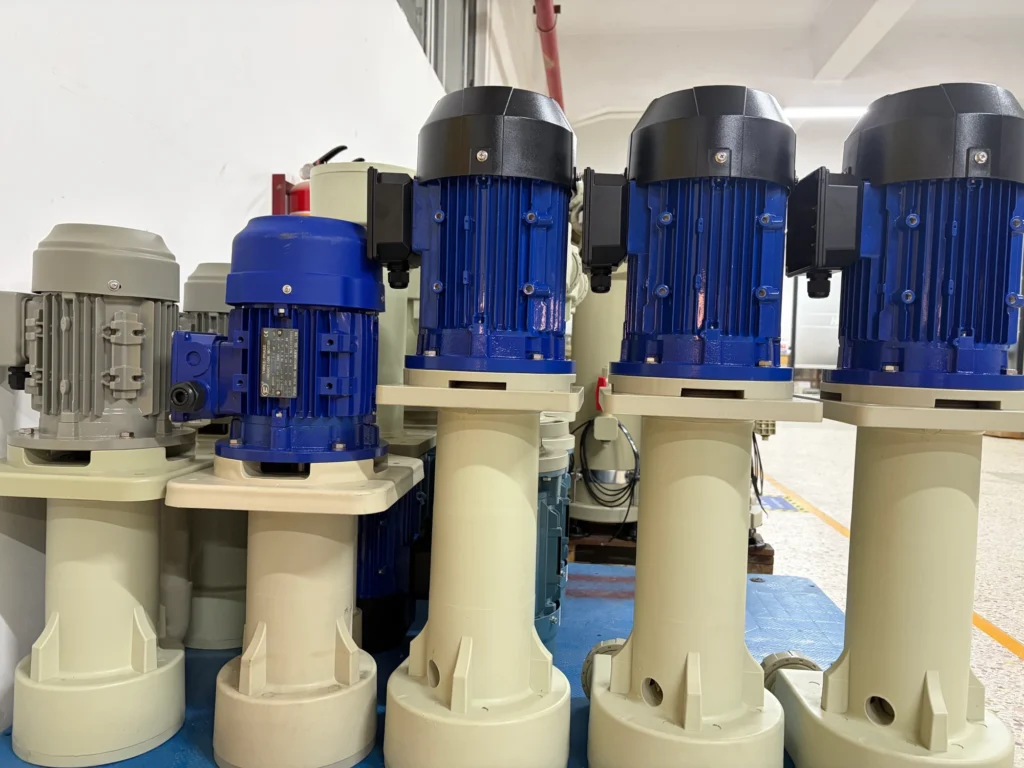
Vertical Chemical Pump
A vertical chemical pump is designed for vertical installation and is commonly used with tanks, chemical storage systems, circulation systems, and industrial processing equipment.
Depending on the design and material, vertical pumps can provide solutions for:
Acid and alkali transfer
Chemical circulation
Cooling systems
Spray systems
Exhaust treatment systems
Etching processes
Their vertical structure can also be useful when installation space is limited.
Centrifugal Chemical Pump
Centrifugal pumps are widely used for industrial liquid transfer because of their relatively simple structure and continuous flow characteristics.
They can be applied to:
Industrial circulation
Chemical transfer
Water treatment
Cooling systems
Filtration systems
The correct pump should be selected according to the required flow, head, liquid properties, and system conditions.
Diaphragm and Dosing Pumps
When accurate chemical dosing is required, diaphragm or dosing pumps may be more suitable.
These pumps are commonly used for:
Chemical dosing
Water treatment
pH adjustment
Chemical injection
Process control
The required dosing rate and chemical characteristics should be confirmed before selecting the appropriate model.
Why Is Pump Material So Important?
For corrosive liquids, the pump material is not simply a product specification—it is one of the most important factors affecting service life.
For example:
Pump Material | Typical Advantage |
FRPP | Good corrosion resistance and cost performance |
PVDF | High chemical resistance for demanding applications |
Stainless Steel | High mechanical strength and suitable for specific industrial media |
However, there is no universal material that works for every chemical.
The correct material depends on the chemical medium, concentration, temperature, flow conditions, and application environment.
Chemical Pump Applications
Hennvi chemical pumps can be used in a variety of industrial applications.
Electroplating
Chemical pumps are used for chemical circulation, transfer, filtration, and processing in electroplating systems.
PCB Manufacturing
Corrosion-resistant pumps can be used for chemical transfer and circulation in PCB production processes.
Semiconductor Industry
Chemical liquid handling requires stable and reliable pumping equipment, particularly when corrosive process chemicals are involved.
Lithium Battery Manufacturing
Chemical pumps can be applied to chemical liquid transfer and circulation processes used in battery manufacturing.
Chemical Industry
Chemical transfer pumps are widely used for transferring, circulating, and processing various aggressive liquids.
Environmental Protection
Chemical pumps and filtration equipment can be used in wastewater treatment, chemical circulation, and exhaust treatment systems.
Need a Reliable Pump Solution for Corrosive Applications?
Hennvi Pump provides engineered chemical pump solutions including magnetic drive pumps, diaphragm pumps,centrifugal pumps, dosing pumps,vertical pumps and filtration systems for industrial applications. Share your working conditions and requirements with us. Our technical team will provide professional suggestions, datasheets and competitive pricing for your fluid‑handling solution.
Hennvi — Chemical Pump Manufacturer
Hennvi is a professional manufacturer specializing in acid and alkali resistant chemical pumps and chemical liquid filtration equipment.
Unlike a simple trading company, Hennvi integrates:
Independent R&D → Mold Development → Manufacturing → Quality Control → Sales → Technical Service
This integrated manufacturing capability allows us to continuously develop and optimize products according to different industrial requirements.
Our product range includes various types of chemical pumps and chemical filtration equipment, including:
Magnetic drive pumps
Vertical chemical pumps
Centrifugal pumps
Diaphragm pumps
Dosing pumps
Chemical filtration machines
Corrosion-resistant pumps
We focus on providing customers with efficient, safe, and reliable solutions for chemical liquid transfer and filtration.
Why Choose Hennvi?
Independent R&D
Hennvi develops and improves products based on real industrial application requirements.
Mold Development Capability
Our own mold development capability helps us control product design and manufacturing consistency.
Multiple Chemical Pump Solutions
Different pump structures and materials are available for different chemical transfer requirements.
Corrosion-Resistant Materials
FRPP, PVDF, stainless steel, and other material options can be selected according to application requirements.
OEM & Custom Manufacturing
We can support customized product requirements and OEM cooperation for qualified customers.
Factory Direct Supply
As a manufacturer, Hennvi provides factory-direct solutions with competitive cost performance and direct technical communication.
What Information Do You Need to Provide When Selecting a Chemical Pump?
If you are looking for a chemical pump, providing the following information can help the manufacturer recommend the correct model:
Chemical liquid
Chemical concentration
Liquid temperature
Required flow rate
Required pump head
Pump installation method
Power supply / voltage
Pump material requirements
Continuous or intermittent operation
Application or equipment
For example:
Medium: Hydrochloric Acid
Concentration: 10%
Temperature: 25°C
Flow: 100 L/min
Head: 15 m
Installation: Tank-mounted
Voltage: 380V / 50Hz
With these parameters, a professional pump manufacturer can evaluate the application and recommend a more suitable solution.
Conclusion
Choosing the right chemical pump is not simply about selecting a pump with the correct motor power.
A reliable solution should consider the chemical properties, material compatibility, flow rate, pump head, temperature, installation method, and operating conditions.
For industries such as electroplating, PCB manufacturing, semiconductor production, lithium battery manufacturing, chemical processing, and environmental protection, selecting the right corrosion-resistant pump can improve system reliability and reduce unnecessary maintenance.
Hennvi combines independent R&D, mold development, manufacturing, sales, and technical support to provide a wide range of chemical pump and filtration solutions for industrial applications.
If you are unsure which chemical pump is suitable for your application, contact Hennvi with your liquid, flow, head, temperature, and application requirements. Our team can help evaluate the appropriate solution.