
Magnetic Drive Pump Threaded vs. Hose Connections for Chemical Lines
Get Product Catalog & Support
Fill out the form to get full specs and case studies.
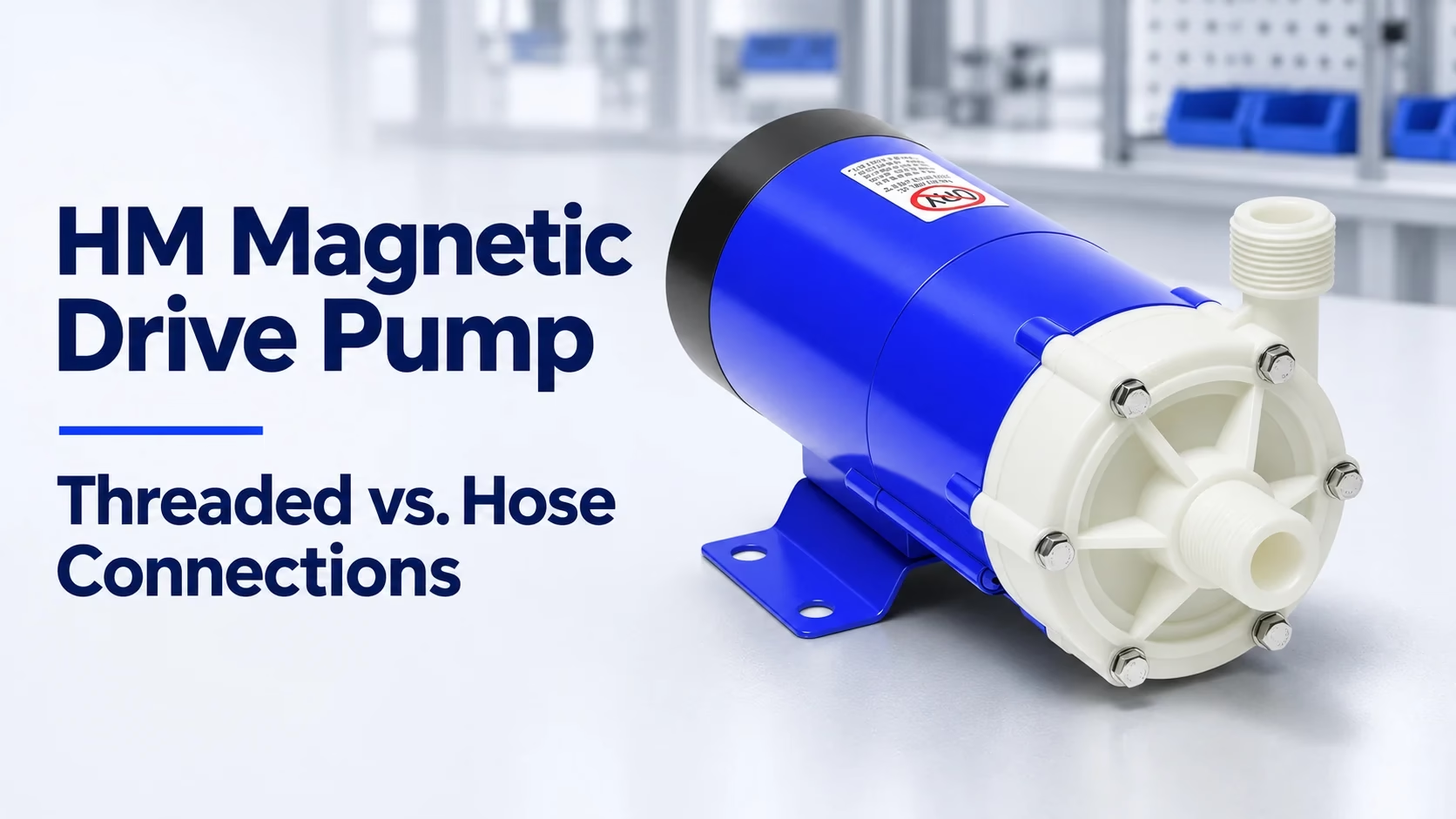
Choose a threaded connection when an HM magnetic drive pump has to fit a fixed pipe run with a known thread standard and independently supported piping. Choose a hose connection when a short flexible section makes routing or pump removal easier and the assembled hose is rated for the chemical, temperature and pressure at that point in the system. On the suction side, that includes resistance to collapse under the lowest expected inlet pressure.
A pump can fit the mounting holes and still be a poor replacement. A mismatched thread can damage a plastic port. A narrow hose tail can restrict the inlet. Rigid pipe that has to be pulled into alignment can put a permanent load on the casing. Check these details before ordering adapters or cutting the existing pipe.
Table of Contents
ToggleWhat S and H Mean on a HENNVI HM Pump
The HM ordering guide uses S for a threaded connection and H for a hose connection. In the catalogue example HM-F-20-4-S-C-V-3-5, the 20 identifies the 20 × 20 mm inlet and outlet size group. The S identifies the threaded version. The F is the FRPP material code, C identifies the ceramic spindle, V identifies the Viton elastomer option, and the final 5 specifies 50 Hz. Confirm the full order code for the proposed build. HENNVI HM Series specifications
| HM model | Published inlet × outlet | Published power | 50 Hz max. flow | 50 Hz max. head |
|---|---|---|---|---|
| HM-20 | 20 × 20 mm | 20 W | 26 L/min | 3.0 m |
| HM-40 | 20 × 20 mm | 65 W | 45 L/min | 4.5 m |
| HM-55 | 25 × 25 mm | 90 W | 60 L/min | 5.6 m |
| HM-70 | 25 × 25 mm | 180 W | 85 L/min | 6.9 m |
The HM catalogue lists water at specific gravity 1.0 as the test fluid. Maximum flow and maximum head describe separate limits. Check flow at the required head on a curve for the exact model and frequency. The nominal sizes in the table identify the pump groups. Use a connection drawing to match actual fittings.

When to Choose Threaded Ports
Threaded ports work well for fixed equipment with a defined connection standard and enough room for a removable joint. A compatible union can let a technician withdraw the pump without cutting pipe or turning the pump body against the pipe. Check the clearance for undoing the union and moving the pump out of the cabinet.
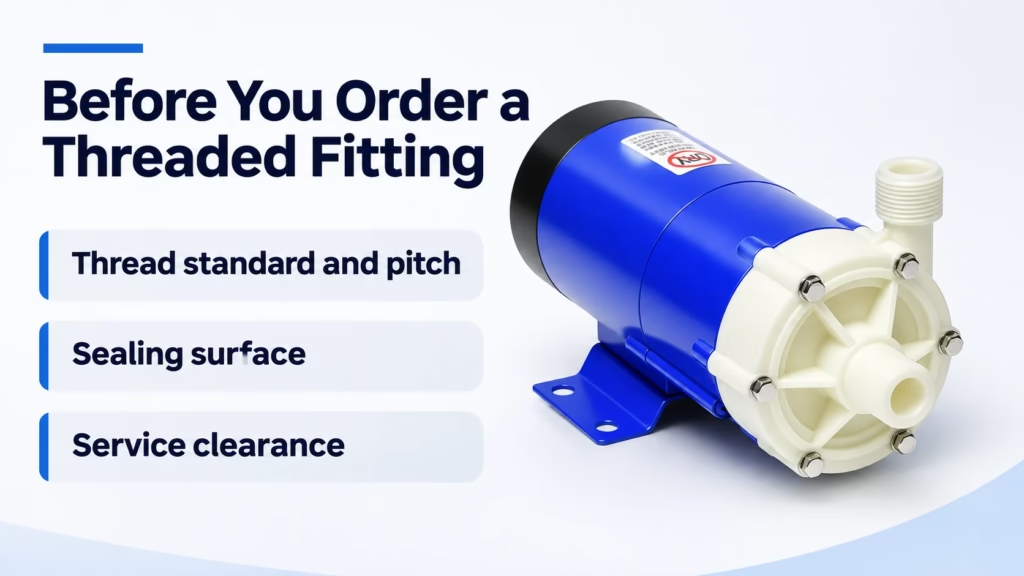
Confirm the standard, pitch, male or female form, and sealing arrangement. Similar diameters can belong to different thread standards. Some fittings seal at the threads, while others seal at a face or an O-ring. Get the connection drawing before choosing an adapter or sealing material. Use the assembly method specified for the actual fittings, especially where a metal adapter mates with a plastic port.
Support the pipe independently so its weight and thermal movement do not load the pump. If an isolated pipe springs away when its old connection is released during maintenance, check the supports and realign the pipe before replacing the pump.
When to Choose Hose Ports
A short, correctly supported hose can simplify routing under a tank or inside a cabinet where rigid pipe would add several elbows. It can also improve service access when the clamps and connections are reachable.
Match the hose inside diameter to the specified hose tail and check the clear bore of the assembled fitting. A hose can have the expected nominal diameter while the tail inside it has a much smaller opening. Verify the hose liner against the process liquid and cleaning fluid, check its pressure rating at the operating temperature, and confirm its suction rating where applicable. Select the hose, tail and retention method as an assembly.
Check the installed bend and support points. A tight bend can pinch the line, and a high loop can trap air. Allow room for the rated bend radius, and route the line so the cabinet or skid carries its weight. T-Mag installation guidance

Why the Clear Bore Matters More Than the Fitting Label
Consider two suction fittings with assumed clear bores of 20 mm and 15 mm. At 20 L/min, the mean velocity in the fitting increases from about 1.06 m/s to 1.89 m/s. For the same local loss coefficient, the velocity-head term in the smaller bore is about 3.2 times larger. Actual losses also depend on the fitting shape and on the adjacent contraction and expansion.
Those are illustrative dimensions. For an actual HM installation, check the drawing or measure the minimum clear bore of the assembled adapters. This is especially useful when a circulation skid worked before a retrofit and became unstable after a reducer and hose tail were added next to the inlet.
Replacement Example Using an HM-40
Suppose a 50 Hz HM-40 recirculates liquid through a small process skid. The existing pump has threaded connections, and the maintenance team wants a short flexible section to make removal easier. Begin with the original operating flow and head. Then request the threaded and hose-port drawings and compare the inlet centerline, mounting footprint, service clearance and fitting bore.
Mark the lowest process tank level and the highest point in the proposed suction hose. If the hose has to arch over a structural member, check whether the route can be lowered to avoid trapping air. Review the pump duty with the final pipe layout. After commissioning under the equipment procedure, compare stable flow and pressure with the old baseline at the same tank level and valve positions.

Frequently Asked Questions
Is a 20 mm HM connection a 3/4-inch pipe thread?
Use the ordered connection drawing to identify the thread. The millimetre figure groups the pump ports by size. The drawing specifies the mating interface.
Can I add a hose adapter to a threaded pump?
A compatible adapter may be possible. Check the thread and seal design, the assembled bore, hose support and the pressure and temperature rating. Compare the layout with the hose-port version if installation space is limited.
What should I send HENNVI for a replacement check?
Send the model code, a readable nameplate photo, photos or drawings of the two connections, and the chemical name, concentration and temperature. Add the required operating flow and head, site voltage and frequency, lowest tank level and a sketch of the suction line. Request an HM configuration review
Need a Reliable Pump Solution for Corrosive Applications?
Hennvi Pump provides engineered chemical pump solutions including magnetic drive pumps, diaphragm pumps,centrifugal pumps, dosing pumps,vertical pumps and filtration systems for industrial applications. Share your working conditions and requirements with us. Our technical team will provide professional suggestions, datasheets and competitive pricing for your fluid‑handling solution.