
How to Read a CQB Magnetic Drive Pump Performance Curve

Get Product Catalog & Support
Fill out the form to get full specs and case studies.
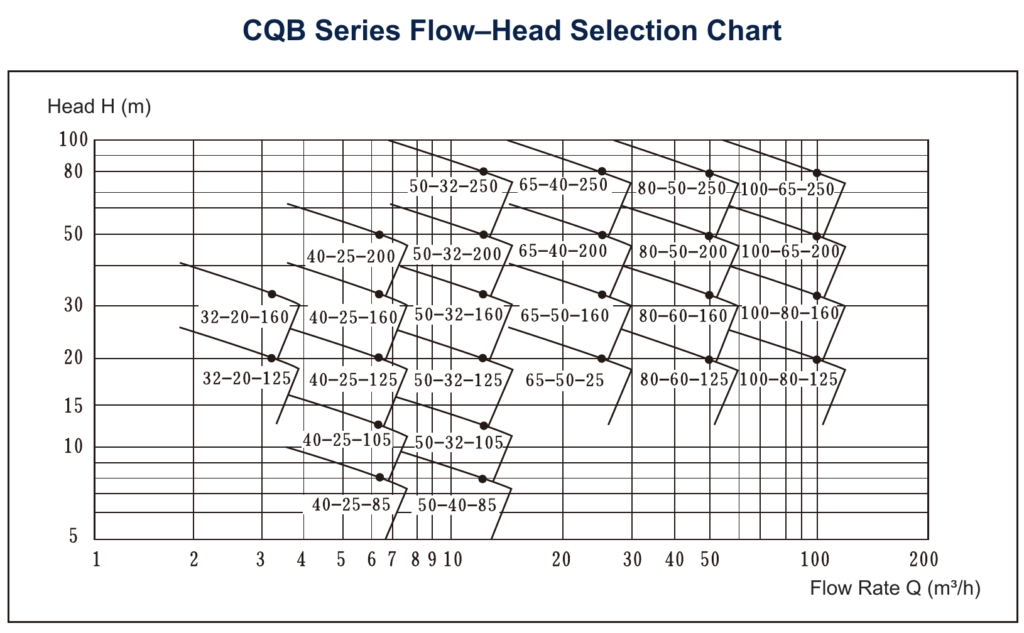
If a chemical transfer line needs 12.5 m³/h at 32 m of total head, start by finding a CQB model that lists both values at the same operating point. The CQB50-32-160 manual lists that combination at 2,900 rpm. At a higher flow of 15 m³/h, the same model is listed at 29 m. Those two rows show why a model that meets one duty may fall short when the process calls for more flow.
A CQB magnetic drive pump performance curve helps you shortlist a model and see how its performance changes as flow increases. Once you have a candidate, compare its curve with the resistance of the actual piping system. Hydraulic Institute guide to pump and system curves
Table of Contents
ToggleWhat the CQB Model Number Tells You
In the manual’s model designation, CQB50-32-160 identifies a 50 mm suction connection, a 32 mm discharge connection and a 160 mm nominal impeller diameter. Use those numbers to identify the hydraulic size when requesting a curve. For a replacement, use the dimensional drawing for the quoted unit to verify the flange standard, bolt pattern, facing and mounting dimensions.

Compare Selected CQB Operating Points
The table below shows selected paired values from the CQB manual at 2,900 rpm. Each row gives the head and shaft power listed at the flow shown.
| Model | Flow | Head | Shaft power |
|---|---|---|---|
| CQB32-20-125 | 3.2 m³/h | 20 m | 0.58 kW |
| CQB40-25-125 | 6.3 m³/h | 20 m | 0.98 kW |
| CQB50-32-125 | 12.5 m³/h | 20 m | 1.62 kW |
| CQB50-32-160 | 12.5 m³/h | 32 m | 2.79 kW |
| CQB50-32-160 | 15 m³/h | 29 m | 2.96 kW |
| CQB65-50-160 | 25 m³/h | 32 m | 5.07 kW |
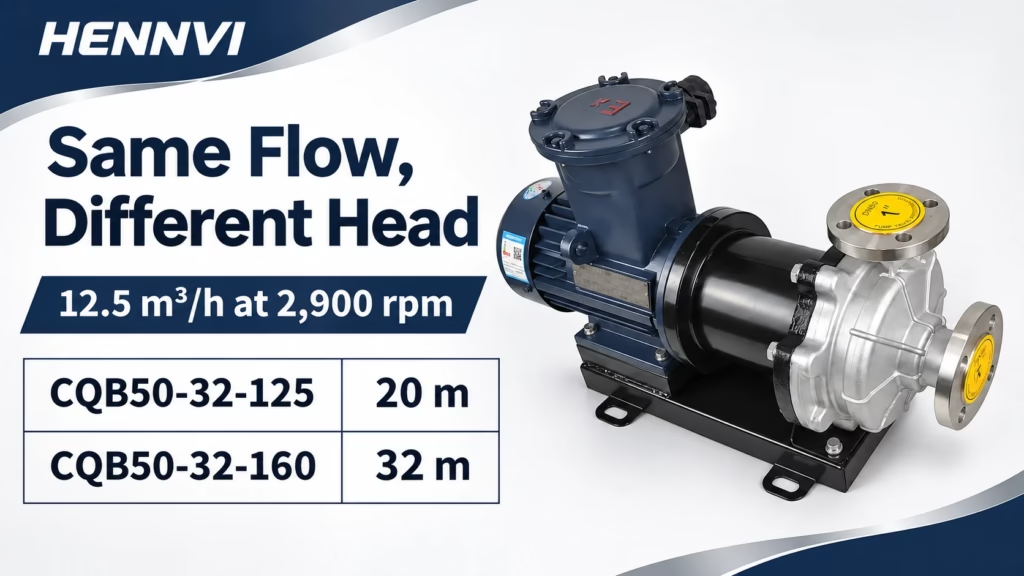
Two models can share the same flow and connection sizes while delivering different head. At 12.5 m³/h, the CQB50-32-125 is listed at 20 m, while the CQB50-32-160 is listed at 32 m. Calculate the total head at your target flow, including elevation or vessel pressure differences and losses through piping, valves and any connected equipment. Then check where the selected pump curve meets the system curve.
Check Motor Power and Suction Conditions Separately
For the CQB50-32-160, the manual lists 2.79 kW shaft power at 12.5 m³/h and 32 m. In its separate motor selection columns, it lists 4.0 kW for the density category up to 1.30 g/cm³ and 5.5 kW for the category up to 1.84 g/cm³. Ask HENNVI to confirm the allowable density, motor rating and magnetic coupling load for the quoted configuration and the full operating range.
The same model lists 3.5 m NPSHr at 12.5 m³/h and 4.0 m at 15 m³/h. Check the NPSH available from the actual suction system at each required duty and confirm the necessary margin. This becomes especially important when the source tank level drops or the liquid temperature rises. Hydraulic Institute pump principles and NPSH guidance

Frequently Asked Questions
Can the CQB50-32-160 deliver 15 m³/h at 32 m?
At 15 m³/h, the manual lists 29 m at 2,900 rpm. If your line needs 15 m³/h at 32 m, request a curve for a configuration that meets that paired duty.
What should I send HENNVI for a CQB quotation?
Send the required flow and total head, liquid composition, temperature, density and viscosity, source tank levels, suction layout and site power supply. For a replacement, include the full model code and photos of the pump and motor nameplates. Ask for the curve and dimensional drawing for the exact assembly quoted.
Need a Reliable Pump Solution for Corrosive Applications?
Hennvi Pump provides engineered chemical pump solutions including magnetic drive pumps, diaphragm pumps,centrifugal pumps, dosing pumps,vertical pumps and filtration systems for industrial applications. Share your working conditions and requirements with us. Our technical team will provide professional suggestions, datasheets and competitive pricing for your fluid‑handling solution.